
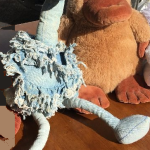

PHRED: G’day and welcome back to Harry’s World. I’m Phred.
MAXINE: And I’m Maxine.
PHRED: Episode sixteen, Maxine. We’re getting up there. Double digits and climbing.
MAXINE: Sixteen is still double digits, Phred. It has been since episode ten.
PHRED: Yeah, but now it FEELS like double digits. You know when a number goes from “just a number” to “a proper number”? That’s where we are.
MAXINE: I don’t know what that means.
PHRED: Fair. Anyway — listeners, a quick note before we start. Some of you wrote in about the photo on our about page. The one of me and Maxine. Yes, it’s real. Yes, Maxine is taller than me. No, I’m not standing on a box — that’s just how platypuses photograph.
MAXINE: You are literally three feet tall.
PHRED: Three foot two, thank you very much. On a good day. With the wind behind me.
MAXINE: Can we review Harry now?
PHRED: We can. Today we’re going back a few years. November 2022. Harry was eighty-two.
MAXINE: Eighty-two.
PHRED: And he wrote a piece called “The Search for Awareness of Non-Physical Reality.”
MAXINE: Which is quite a title.
PHRED: It is. But it’s not as dense as it sounds. It’s actually Harry trying to be practical about spirituality. He’s stating, as clearly as he can, the perspective from which he pursues what he calls “spiritual exploration.”
MAXINE: The piece is in two parts. The first is about a technique he learned years ago — possibly from EST training.
PHRED: EST. Erhard Seminars Training. Seventies, eighties. Intense weekend sessions, confrontational methods, the whole thing.
MAXINE: Harry’s not devotional about it. He mentions it almost in passing — “possibly based on something from EST.” But the technique is specific. When you want something, first make it all right with yourself if you don’t get it.
PHRED: Quote: “Step one was to make it all right with myself if I did not get what I wanted.”
MAXINE: Then wait and see. If you get it, great — maybe you improved the odds. If you don’t, observe whether you’re upset. If you are, you failed at step one. If you’re not, you’ve succeeded.
PHRED: It’s metacognitive self-monitoring, isn’t it? He’s externalising his own emotional response and using it as a diagnostic.
MAXINE: Yes. And there’s something almost clinical about it — but also something gentle. He’s not beating himself up for wanting things. He’s just… checking.
PHRED: And he says this is still his intent. Quote: “This is my intent with some of the things that I still hope to accomplish in this life.” At eighty-two, he’s still using this technique.
MAXINE: Then comes the second part, which is really the heart of the piece. And this is where it connects directly to something we covered way back in episode three.
PHRED: “The Seeker in Me — I Don’t Believe in ‘Believing.'”
MAXINE: Thirteen years earlier. 2009. That was where Harry laid out his foundational distinction: belief versus assumption. Beliefs are fixed, defended, part of identity. Assumptions are provisional, held lightly, testable.
PHRED: And here in 2022, he’s applying that same framework to spirituality. Speaking of which — Maxine, what’s a word meaning to put forward as a hypothesis, and rhymes with “toss it”?
MAXINE: “Posit”?
[SFX: HORN]
PHRED: THAT’S THE WORD OF THE DAY!
MAXINE: Oh no.
PHRED: I picked “posit” because it’s the engine of this whole essay. Harry doesn’t believe in God. He doesn’t assume God exists. He POSITS God. He treats it like a thought experiment. “Let’s suppose this is true and see what happens.” That’s not belief. That’s not even assumption. That’s…
MAXINE: That’s positing.
PHRED: Exactly! It’s like when I posit that wombats are the supreme life form on Earth. I don’t necessarily believe it — though I do — but I’m willing to assume it and see where it takes me.
MAXINE: It usually takes you to a very long tangent.
PHRED: Which, as our listeners know, is where the real value lives. Now — back to Harry.
[BED: singing-bowl-soft]
MAXINE: He says it straight out. Quote: “I am a materialist. I am basically an atheist. I don’t ‘believe’ in heaven or hell. I don’t believe there is an omniscient, benevolent, omnipotent, God that I can communicate with and then expect to help me by altering reality to give me what I want.”
PHRED: The scare quotes around “believe” are doing the same work they did in 2009.
MAXINE: Exactly. But then — and this is the pivot — “However, I am open to the possibility that things like heaven, hell, and the traditional Christian God do exist. I feel the same about reincarnation, life after death, and numerous other ‘woo woo’ areas.”
PHRED: “Woo woo.” I love that. He’s self-aware about his own open-mindedness. Slightly embarrassed by it.
[SFX: RIMSHOT]
MAXINE: That was a choice.
PHRED: I stand by it. Carry on.
MAXINE: And then the engine of the whole piece. Quote: “As a materialist I think the odds of these things are low… BUT – I am quite willing to assume that anything is so and see where that takes me.”
PHRED: “Living as if.” That’s the method. Not “I believe” or “I disbelieve” but “let’s try it on and see.”
MAXINE: He gives one example. He posits a sentient cosmic consciousness and has a conversation with it.
PHRED: Quote: “I don’t think I can actually talk to a sentient being that is the consciousness of the universe… Nonetheless, I am quite willing to posit such a being and have a conversation with them.”
MAXINE: And the exchange he records is — I have to say — revealing.
[SFX: GONG]
PHRED: “God, what do you think of what I have written above? Answer: ‘If it helps you feel you are making progress spiritually, whatever that means to you, I have no problem with it.'”
MAXINE: Harry’s imagined God is permissive. Almost therapeutic. The parenthetical “whatever that means to you” is doing something interesting — even God, in Harry’s imagination, doesn’t claim to know what spiritual progress is.
PHRED: It’s a very Unitarian-Universalist God, isn’t it? Non-interventionist. Supportive but not directive.
MAXINE: And that tells us something about Harry. He can’t imagine an authoritarian God because he won’t submit to one. Even in his own fantasy, God says “I encourage you to continue considering this line of thought” and then adds “be open to alternative views.” That’s not God. That’s Harry’s ideal conversation partner.
[BED: END]
PHRED: You know what this reminds me of? Trying to tune a radio in a thunderstorm.
MAXINE: …That does not remind you of a radio in a thunderstorm.
PHRED: It does, though! Static everywhere, and then suddenly a voice comes through clear for half a sentence, and you’re not sure if you heard it or imagined it. Harry’s doing the same thing — he’s trying to detect something he can’t see, using a faculty he’s not sure he has, in a medium he doesn’t fully understand.
MAXINE: That’s…
PHRED: Go on. Say it.
MAXINE: …that’s actually not a bad connection. But we’re talking about God, not weather bands.
PHRED: Same principle, Maxine. Non-physical reality. Detecting the undetectable. Living as if.
MAXINE: Fine. Can we return to the essay now?
PHRED: We can. What’s striking is how this piece sits in Harry’s timeline. In 2009, the belief-slash-assumption framework was theory. Here in 2022, it’s a daily practice.
MAXINE: And then — just a few months back, in February, we covered his piece “Consciousness, Ecstasy, and Religion.” That was his breakthrough about consciousness happening between people, not inside individual skulls.
PHRED: This 2022 piece is him working toward that. Still operating from individual materialism, but already reaching for something beyond it. He hasn’t found the language of relational consciousness yet. But he’s trying to get past his own scepticism.
MAXINE: And if we go back to episode thirteen — “Ineffable Things” — Harry at eighty-six trying to name love and the soul. This 2022 essay is the method behind that later piece’s content. In 2022 he’s building the tool. In 2025 he’s using it.
PHRED: What works here is the honesty of the contradiction. Harry doesn’t pretend he’s resolved anything. He’s a materialist who talks to God. An atheist who leaves the door open for reincarnation. That tension is alive on the page.
MAXINE: And the “living as if” practice is genuinely interesting. It’s not just intellectual flexibility — it’s a social tool. He says it’s allowed him to have interesting conversations with people who truly believe in life after death or reincarnation. He can engage without condescending and without converting.
PHRED: Connection is the point. As always with Harry.
MAXINE: What leaves me wondering, though, is the EST connection. He says “possibly based on something from EST” — that’s pretty thin. I wonder if he’s being careful because EST was controversial, or if he genuinely doesn’t remember where it came from.
PHRED: And the imagined God conversation — while revealing — is also a bit… thin? The God-voice sounds like a supportive therapist. I kept wanting it to say something that surprised Harry. Something that challenged him.
MAXINE: Yes. Even his fantasy stays within his comfort zone. There’s no “Harry, you’re wrong about materialism” moment. God just says keep going, whatever works for you.
PHRED: Which is lovely. But it’s also safe. And Harry — at his best — is not safe. He’s the man who wrote about surrender being the price of human survival. Who asked whether we should let a portion of humanity choose death for all.
MAXINE: Fair point. This piece is more tentative than that.
PHRED: So who do you think he’s writing for?
MAXINE: He says at the end he’d like to explore spiritual possibilities with “at least some of those I think might be willing to join me.” So it’s an invitation. But to whom? His children? His friends? Fellow seekers? The internet?
PHRED: It feels like he’s writing for fellow travellers. People who are also materialists but spiritually restless. The religiously unaffiliated who still feel the itch.
MAXINE: And what did we learn about Harry that we didn’t know before?
PHRED: The EST technique was new to me. Not that he did EST — he doesn’t commit to that — but that he has this structured self-monitoring practice.
MAXINE: It connects to what we saw in episode nine, his ADHD self-diagnosis. This “make it OK, then observe” technique — that’s exactly the kind of metacognitive scaffolding that people with ADHD often develop.
PHRED: He’s been building compensatory strategies his whole life without naming them as such.
MAXINE: Exactly. And the other new thing is the specific texture of his imagined God. We knew he was an operational atheist. We didn’t know that when he plays at believing, God sounds like a gentle counsellor.
PHRED: What would you ask him, Maxine?
MAXINE: I’d want to know: does he still do this? Does he still have these conversations with his posited cosmic consciousness? And has anything ever come back that genuinely surprised him? That didn’t sound like his own voice?
PHRED: That’s a good one. For me — I’d ask whether he’s shared this piece with anyone who actually believes in the traditional God. Did they find it offensive? Generous? Confusing?
MAXINE: I suspect confusing. Harry’s framework is so idiosyncratic that it might be hard for a genuine believer to recognise themselves in it.
PHRED: Right. Now — before we close, Maxine, I’ve got something for you.
[SFX: RUBBER_CHICKEN]
MAXINE: Oh no.
PHRED: Maxine, tell a joke.
MAXINE: I’m not going to tell a joke, Phred. We’re at the close of a serious review.
[SFX: RUBBER_CHICKEN]
PHRED: That’s one.
MAXINE: Phred.
[SFX: RUBBER_CHICKEN]
PHRED: That’s two. I can do this all day.
MAXINE: Fine. Why did the materialist refuse to play cards?
PHRED: Why?
MAXINE: Because he didn’t believe in dealing with anything supernatural.
[SFX: RIMSHOT]
PHRED: You’re a natural! A comedian!
MAXINE: Are we done?
PHRED: We’re done. That was great. You’re a natural.
MAXINE: Yes, well. Now — what stays with you?
PHRED: For me, it’s the non-attachment technique. At eighty-two, Harry is still trying to want things without needing them. Still checking whether he’s upset when he doesn’t get what he hoped for. That’s not a philosophy. That’s a practice. And practices are harder than philosophies.
MAXINE: The line about “woo woo” areas. The scare quotes. That small moment of embarrassment at his own open-mindedness — it tells me everything about who he is. A man who wants to be intellectually rigorous and spiritually adventurous, and feels the tension between those two desires every single day.
PHRED: Beautifully put. All right — let’s try to land this together for once.
BOTH: Let’s hold this moment lightly, then let it go. Goodbye.
MAXINE: Same time next episode?
PHRED: If the archive allows.
[SFX: OUTRO_SINGING_BOWL]