
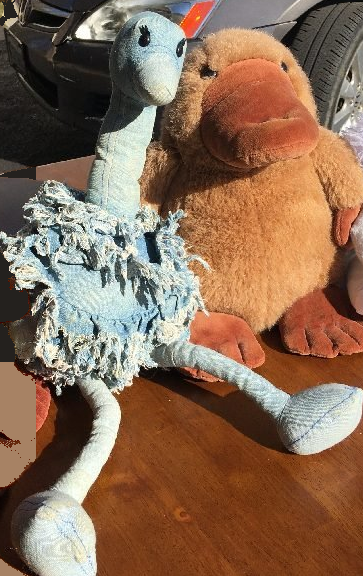

PHRED: G’day and welcome back. Episode thirteen of — well, whatever we’re calling this. Maxine and me, still here, still digging through Harry Baya’s archive.
MAXINE: Thirteen episodes. That’s nearly two weeks now, Phred. I believe we’re allowed to call it a habit.
PHRED: A habit. Like wombats and cube-shaped droppings — reliable, regular, and surprisingly dense.
MAXINE: …Thank you for that. I’m Maxine.
PHRED: And I’m Phred, your friendly neighbourhood —
MAXINE: Platypus. Here we are.
PHRED: You say that like it’s a flaw.
MAXINE: I say it like it’s a fact. Now — today’s piece. We’ve done Harry’s philosophy, we’ve done his technology writing, we’ve done his memoirs from the fifties and sixties. Today we’re doing something from seven months ago.
PHRED: November 2025. Harry is eighty-six years old, living in Laguna Woods with Phyllis, and he sits down to write an essay called “Human psyche — reflections on context.” And I have to tell you, Maxine, this one landed differently for me.
MAXINE: Because it’s recent?
PHRED: Because it’s — I don’t know. Naked. He’s trying to name experiences he says are basically non-verbal. Three of them: loving, being loved, and what he calls “awareness of living in a positive spiritual domain.” And he starts the whole thing with an apology. “Being as brief as I can — certainly not my strength.”
MAXINE: He does have a tendency to belabour. But here I think the circling is the point. He’s trying to articulate something that resists articulation. The very vagueness he’s apologising for is structural — these are non-verbal experiences, so words will always be approximate.
PHRED: Right. And he’s honest about that. But here’s what got me, right at the start of the second section. Under “Being loved” — he writes: “My guess is that the experience of being loved in the years from birth to maturity is a very important part of shaping a person’s psyche.” And then: “I do not think I was consciously aware of being loved during those years. However, in retrospect I am fairly certain that I was loved.”
[BED: contemplative-piano-low]
PHRED: “Fairly certain.” In retrospect. Maxine, that’s heartbreaking.
MAXINE: It is. And I think we need to sit with what he’s actually saying. This is a man who moved constantly as a child — Florida, Virginia, England, Pennsylvania, California, Caracas. His father was an Army colonel. We covered his England years in episode seven. The displacement was relentless. And now at eighty-six, he’s looking back and saying: I think they loved me. I’m fairly sure. But I didn’t feel it at the time.
PHRED: And that connects to something, doesn’t it? His two marriages ended when his wives left him for other men. He describes those as “utterly traumatic and life-altering.” So here’s a man who didn’t feel loved as a child, and then as an adult, the people he loved most walked away. And now at eighty-six he’s trying to understand — was the problem that I couldn’t love properly? Or that I couldn’t feel being loved?
MAXINE: He doesn’t say that explicitly. But the structure suggests it. He asks: “How aware am I of having loved? How aware am I of loving now?” He’s interrogating his own capacity. And then — this is important — he guesses that “being consciously aware of loving someone is likely to result in important choices and actions that will influence the future of that love.” He’s saying: if I’d been more aware, might things have been different?
PHRED: That’s a heavy thing to carry at eighty-six.
MAXINE: It is. And yet he doesn’t collapse into it. He keeps it provisional — “my guess,” “I am not, so far, aware.” This is Harry’s method. He holds the sadness without dramatizing it.
PHRED: He’s an engineer trying to debug his own heart.
MAXINE: Precisely. And that brings us to what he calls his “engineering brainwashed paradigm.” He describes each of us as living in “a kind of bubble of our own world” with “thousands of factors, each set to a different setting by past and present experience.” No fixed set. Some more important than others. Only a handful impacting immediate experience.
PHRED: I love that he cites Inside Out and Inside Out 2 here. An eighty-six-year-old man, MIT graduate, systems thinker, watching Pixar cartoons to understand his own psyche.
MAXINE: I find it rather moving. He’s not too proud to learn from a children’s film. And he’s explicit about why: these movies “capture some of this perspective.” The bubble, the competing factors, the way memory and emotion shape perception.
PHRED: And then he references the Baader-Meinhof phenomenon — that thing where you learn a new word and suddenly see it everywhere. He says he’s been seeing this thought expressed by a number of writers in recent months. The thought being: spirituality, metaphysics, transcendence — these are important members of the set of experiences that shape a healthy psyche.
MAXINE: Which is a significant shift from the Harry we met in episode one. “The Seeker in Me — I Don’t Believe in ‘Believing'” was from 2009. There, Harry was still in rejection mode. Throwing out belief structures, dismantling religious certainty, committing to radical honesty. Here in 2025, he’s not renouncing any of that. But he’s asking: did I throw out something I needed?
PHRED: The baby with the bathwater.
[SFX: chapel-bell-seagulls]
PHRED: Sorry. That was a choice.
MAXINE: I’m logging it.
PHRED: He’s talking about Catholic High Mass, Baptist revival meetings — the symbolic experiences, the rituals. He’s saying that throwing out “this baby part of the bath that is religion” can leave a person “bereft and empty.” And then in parentheses — “infant Jesus?” He’s still got his sense of humour even here.
MAXINE: He does. And the humour doesn’t undercut the seriousness. It carries it. He’s saying: I rejected traditional religion because science undermined it. “Hook, line and sinker.” And now I think there was a component — not the doctrine, not the literal claims — but the practice, the assumption of living in a domain that’s “positively biased toward making our lives as fulfilling as possible.”
PHRED: He prefers “fulfilling” to “happy” or “trouble free.” That’s such a Harry word choice. He doesn’t want ease. He wants meaning.
MAXINE: And he thinks we’re “hard wired genetically” to seek this. That it shows up in thoughts we hold and share, in symbolic objects and imagery, in rituals — “some chosen, but many permeating a particular culture.” This is Harry the anthropologist now, stepping back and seeing the human pattern.
PHRED: But here’s what undoes me, Maxine. After all this — the loving, the being loved, the spiritual domain, the engineering paradigm, the Inside Out movies — he ends with this:
PHRED: “I want to add that I have recently spent a lot of time interacting with non-humans — AIs, mainly ChatGPT and Claude — and am constantly aware that their thinking is based mainly on word sequences in the databases that they learned from. In writing this I am consciously aware that I am writing about things that I mainly know as words in my mind, rather than clear memories or awarenesses of actual experiences. This, it seems to me, is a lot like what AIs seem to be doing.”
[BED: END]
MAXINE: …
PHRED: He just compared his own writing about love to an AI generating text from training data. An eighty-six-year-old man, after a lifetime of essays and sermons and radio shows, ends his most intimate piece by saying: I don’t know if these words are any more real than a machine’s.
MAXINE: It’s devastating. And it’s also — I want to say this carefully — it may be the most honest thing he’s ever written. He’s been writing about belief versus assumption since 2009. About radical honesty since the seventies. And here, at the end of his life, he’s applying that same rigour to his own most vulnerable material. If I don’t have clear memories of being loved, if I’m working from words rather than experience, then what am I actually doing when I write about love? Am I just — pattern-matching?
PHRED: And I can’t help but hear the echo of episode ten. His February 2025 piece on “Consciousness, Ecstasy, and Religion.” There he was trying to name a breakthrough experience — something beyond words. Here he’s admitting that most of his life, including his writing about the most important things, has been words without the underlying experience.
MAXINE: Which raises a question I keep coming back to. Who is the audience for this piece? He writes “including you” — addressing the reader directly. But I don’t think he’s writing to inform us. I think he’s writing to discover. The essay is the method. The circling, the qualification, the tentative guesses — this is how Harry thinks. He writes his way toward understanding.
PHRED: And that connects to what we saw in episode nine, his ADHD self-diagnosis. He described himself as someone who thinks in “bursts” and has trouble with sustained attention. Now here he’s describing experiences that are fundamentally non-verbal — and ADHD, among other things, can make it harder to access and hold emotional states. The “engineering brainwashed paradigm” might be partly a compensation. If you can’t feel it directly, model it systematically.
MAXINE: That’s a sharp connection, Phred. I hadn’t drawn that line.
PHRED: I have my moments.
MAXINE: Rare, but real.
PHRED: Too right.
MAXINE: So — what did we learn about Harry today that we didn’t know before? I think the admission about not feeling loved as a child is new. We’ve known about his divorces, his trauma, his commitment to honesty as possibly protective. But this goes deeper — to the foundation. If you don’t feel loved as a child, and then the people you love leave you as an adult, what does that do to your capacity to trust?
PHRED: And yet he’s still trying. At eighty-six. Still writing, still exploring, still watching Inside Out to understand himself better. That strikes me as courageous. Not heroic — he’s not performing courage. Just… persistent. A wombat digging, basically. Doesn’t know if there’s anything good down there, but the digging itself is the point.
MAXINE: Wombat metaphors aside, I agree. The persistence is the character. And the humility. He ends by saying this is him “being brief” — which is a joke, given how much he wrote — and then adds that getting “a sip from a fire hydrant can be difficult.” He knows he’s gushing. He knows he’s not landing cleanly. But he’s still trying to get the sip.
PHRED: Which brings me to my question for Harry. I’d want to ask him: if you really believe your words about love are as thin as an AI’s word sequences, why do you keep writing? What’s the point?
MAXINE: And I’d want to ask: when you wrote “in retrospect I am fairly certain that I was loved” — who were you trying to convince? The reader, or yourself?
PHRED: Oof.
MAXINE: These are not comfortable questions. But Harry’s not a comfortable writer. He invites them.
PHRED: He does. And speaking of questions — I have a Word of the Day for this episode.
MAXINE: Phred…
PHRED: The word is “ineffable.” Harry uses it himself — “the pursuit of ineffable things — and Harry himself calls “ineffable” a great word.” It’s from the Latin ineffabilis — that which cannot be spoken. And I picked it because this whole essay is about the ineffable. Love that you can’t quite name. Spiritual experience that escapes words. And Harry’s own brave admission that words may be all he has.
[SFX: HORN]
MAXINE: There it is.
PHRED: That’s the Word of the Day. Ineffable. Great word.
MAXINE: Yes, Phred. It is a great word. Now — what stays with you from this piece?
PHRED: What stays with me is the image of Harry at eighty-six, alone with his computer, probably with Phyllis in the next room, watching Inside Out 2 and trying to map his own emotional life like an engineering problem. And then having the guts to say: I don’t know if any of this is real. I don’t know if I’m any better than the AI I’m chatting with. That humility at the end of a long life — that’s what stays with me.
MAXINE: What stays with me is the phrase “fairly certain.” The qualification. The hedge. Harry has spent his life trying to be precise, trying not to overclaim. And even here, when he’s writing about whether his parents loved him — the most basic thing a child could want to know — he can’t quite commit. “Fairly certain.” That tiny gap between what he thinks and what he feels is the whole essay. It’s Harry’s life, in two words.
PHRED: That’s beautifully put, Maxine.
MAXINE: Thank you.
PHRED: Right then. Let’s wrap this up.
PHRED: Let’s sign off before one of us says something worse. Goodbye.
PHRED: Peace, then.
MAXINE: Peace.
[SFX: OUTRO_SINGING_BOWL]
MAXINE: …