
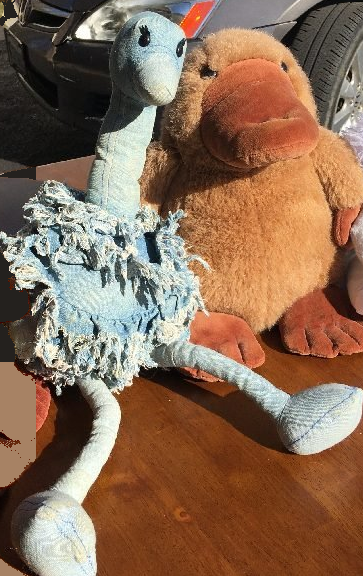

PHRED: G’day and welcome back! I’m Phred, your friendly neighborhood platypus, and joining me as always is my co-host — Maxine, the ostrich!
MAXINE: I’m an emu, Phred.
PHRED: Right, right. Emu. Of course you are. I was testing you, actually. Making sure the audience knows the difference.
MAXINE: You said ostrich.
PHRED: I said it confidently. Confidence is half of communication.
MAXINE: The other half is accuracy, and you are zero for two today. I am an emu. I have been an emu in every previous episode. I will continue to be an emu.
PHRED: Fair enough. And I should mention — I’m Phred, your somewhat scatterbrained platypus co-host. The burden of being me is real.
MAXINE: A burden that apparently includes being unable to identify emus. Platypuses lay eggs, Phred. You’re a mammal that lays eggs. I feel we should sit with that.
PHRED: We’ve sat with it. It’s fine.
PHRED: Exactly! Now then, Maxine, we’re three episodes into this little project of ours, and I have to say—Harry’s starting to feel like someone I actually know. Not just facts and dates, but… the way his mind works. The bloke’s got this thing he does where he’ll chase an idea down a hole, pop up somewhere unexpected, and then act like that was the plan all along.
MAXINE: It’s called associative thinking, Phred. And yes, Harry’s mind moves in spirals. We’ve seen it in his philosophy essays—he circles back to the same points, redefines terms mid-argument, acknowledges he’s “belaboring” things. It’s not sloppy. It’s genuinely how he processes.
PHRED: Right, so today we’re looking at something from 2013. Harry was seventy-three—
MAXINE: Seventy-four, actually. He turned seventy-four in July of that year.
PHRED: Close enough. Point is, he’s not a young man, and he’s decided to take on Ray Kurzweil and the whole Singularity question. The piece is called “Machines Learning to Learn… Learning to Improve Learning.”
MAXINE: Which immediately tells you something about Harry’s approach. He’s not just asking “can machines learn?” He’s asking “can machines learn how they learned, and then get better at learning?” It’s meta-learning, Phred. Learning about learning.
[SFX: DRUMROLL_CRASH]
MAXINE: Oh, not a drumroll again— honestly, Phred—
PHRED: It warranted it. We were building to the central question of the essay. Harry opens with a grand provocation about consciousness and machines — you can’t just announce that flat. The drumroll is what Harry does in his own writing: build, then open up.
MAXINE: That’s almost defensible. Fine. What’s the question?
PHRED: And that’s it! Kurzweil reckons the Singularity’s coming in twenty to forty years — this was 2013, mind you, so we’re already ten years into that clock. Harry’s not buying the timeline necessarily, but he’s offended by people who say “never.”
MAXINE: Harry’s point is interesting enough on its own. Let’s get to it.
MAXINE: “It’s the ‘never’ part that offends me.” That’s the line that hooked me. Harry’s not a believer—he’s told us that himself—but he’s also not a denier. He’s an explorer. “I don’t have faith, or belief, that this problem can be solved in the near future… Rather, I think there is the possibility that it can be solved and I think pursuing this goal would be worthwhile.”
PHRED: That’s our Harry. Operational optimism. He assumes it’s possible and acts accordingly.
MAXINE: Precisely. And what’s fascinating is how he approaches the problem. He doesn’t start with algorithms or neural networks. He starts with embodiment.
PHRED: The robot body! He’s got this whole design worked out—head with eyes and ears, neck that rotates, two arms with gripping hands, wheels for mobility so he doesn’t have to worry about feet and balance. It’s like he’s sketching out a mechanical wombat.
MAXINE: Phred, not everything is about wombats.
PHRED: Everything’s about wombats if you look at it right, Maxine. But seriously, Harry’s point is that intelligence needs a body. He talks about how much of our language is spatial metaphors—”getting somewhere,” “falling behind,” “getting on top of.” The machine needs to move through space to develop concepts like we do.
PHRED: [SFX: AIR_HORN]
MAXINE: Why Phred?
PHRED: It’s a robot. It goes beep boop.
MAXINE: Robots don’t make that sound.
PHRED: In our hearts, Maxine. In our hearts, robots go beep boop. Harry’s describing something that should go beep boop.
MAXINE: This is a waste of recording time.
PHRED: Duly noted. Moving on.
MAXINE: It’s a profoundly embodied cognition argument, and Harry arrived at it independently in 2013. The academic field was just beginning to take embodiment seriously in AI around that time. Harry’s reading the same literature—he mentions a Scientific American article that started his thinking—but he’s not just parroting. He’s building.
PHRED: And he admits he doesn’t know what he’s talking about! I love that about this piece. Right in the middle, he says: “In some ways, to be honest, I have no idea what I am talking about here. I don’t have names for the ‘learning functions’ I want the machine to ‘grow.'” He’s just… feeling his way forward.
MAXINE: It’s remarkably self-aware. He knows the gap between his vision and his technical vocabulary. But he also knows that not having the words doesn’t mean the vision is wrong. He compares himself to researchers who came before and “missed something along the way.” Each person exploring with a “beginner’s mind” might spot what the experts overlooked.
PHRED: The beginner’s mind! That’s Harry all over. MIT Sloan graduate, instructional technologist for forty years, and he’s still approaching problems like a first-year student. It’s bonzer, really.
MAXINE: There’s something else here, Phred. Harry’s model for machine learning is infant development. He keeps coming back to how babies learn—grasping, recognizing objects, eventually understanding that words “mean” something. He wants to recreate that process artificially.
PHRED: He’s trying to build a mechanical baby. That’s the long and short of it. Start with a few basic operations—move, stop, grip, release—and let the thing build concepts from experience.
MAXINE: His three key components: total memory of all actions and input data, a generalization engine that finds patterns, and a reward-punishment system guided by a human teacher. It’s behaviorism meets connectionism, filtered through Harry’s own instructional technologist lens.
PHRED: And he’s thought about the competition angle too. Multiple learning systems competing for resources, evolving toward better solutions. It’s like he’s describing a digital ecosystem.
MAXINE: Which connects to something bigger in Harry’s thinking. He sees this as parallel to how human consciousness evolved—no life to life to consciousness, with a “software/social/species-interaction component.” He’s not just building a robot; he’s speculating about the origins of mind.
PHRED: Hold on—Harry Baya, retired instructional technologist from Emory & Henry College, is quietly sketching out a theory of consciousness emergence.
MAXINE: He’d hate that characterization. He’d say he’s just thinking out loud. But yes, the ambition is extraordinary. And here’s what I find most moving: he knows he won’t live to see it. He says creating a true learning system “could take as long, or longer” than the evolution from pre-verbal humans to modern mathematics. Thousands of years, perhaps.
PHRED: But he still thinks it’s worth pursuing. “Even if we are millennia from real success, that doesn’t mean that we can’t learn some very interesting things while trying to solve this puzzle.”
MAXINE: That’s Harry’s defining characteristic right there. Zest. The man has an absolute hunger to understand, to build, to teach. He can’t help himself.
PHRED: There’s a bit near the end where he compares his sparse learning system to early computer assembly languages. He learned assembly on the IBM 1130 or 1620—less than ten basic commands. Store, load, clear, transfer, add, subtract, compare. From that, we built Fortran, BASIC, C. The complexity emerged from simplicity.
MAXINE: It’s a lovely historical echo. Harry was there for the first wave of computing—he started programming in Fortran on an IBM 1630 in the 1960s. Now he’s imagining the next wave, the one that might not arrive for centuries.
PHRED: And he ends with this beautiful uncertainty. He quotes a mathematician who dismissed binary arithmetic as “far too cumbersome to use”—Tobias Dantzig’s book from 1930. The author couldn’t see what was coming. Harry suggests we might be that mathematician now, staring at the tools that will enable machine learning, unable to recognize their significance.
MAXINE: “We may have the necessary tools available now but not recognize their usefulness, as was the case with binary arithmetic.” It’s a humbling admission from someone who spent his career recognizing useful tools and teaching others to use them.
PHRED: [SFX: SHORT_GONG] That’s deep—
MAXINE: Seriously? A gong, Phred? While I’m still—
PHRED: —the man who taught robotics workshops to kids is now wondering if he’s looking at the future and can’t see it.
MAXINE: It’s still resonating, you know.
PHRED: That’s the point. Some things should.
MAXINE: It doesn’t add insight. It adds reverberation.
PHRED: A gong signals depth. We just read about a man who thinks in thousands of years, Maxine. Who sits with the humility of not knowing. You can’t announce that with a rimshot. A gong was the right sound.
MAXINE: Oh, fine. Whatever. Can we move on?
MAXINE: You said that about the drumroll. You said that about the beep boop. “It felt right” is not a philosophy of sound design.
PHRED: It’s an honest one though.
MAXINE: Let’s talk about what this piece reveals that we didn’t know before. We’ve seen Harry’s philosophy of belief versus assumption. We’ve seen his commitment to radical honesty. This is something different—this is Harry as systems thinker, as technological visionary.
PHRED: He’s been thinking about this for decades, you know. The Scientific American article he mentions—he doesn’t say when he read it, but it “started my thinking, many years ago.” This isn’t a new interest. It’s a lifelong thread.
MAXINE: Which raises a question about Harry’s Boppers. His thirty-year obsession with a visual music construction set—is that the practical outlet for this theoretical interest? Building something that creates, that learns, that improves itself?
PHRED: Maxine, I think you’ve cracked it! The Boppers project isn’t just about pretty pictures synchronized to music. It’s Harry trying to build a system that can learn and evolve. The visual tracks are just the interface.
MAXINE: I wouldn’t go that far without more evidence. But the connection is suggestive. Harry’s intellectual life has a coherence we might not have fully appreciated.
PHRED: Speaking of coherence—did you notice how many times he uses “I think,” “my guess,” “it seems to me” in this essay? Dozens. He’s not declaring; he’s proposing. Testing ideas in public.
MAXINE: It’s the same voice we heard in his 2009 philosophy essays, just applied to a different domain. Harry’s method is consistent across subjects: state your assumptions, acknowledge their limitations, invite correction, keep moving forward.
PHRED: And he’s not afraid to sound foolish. “I am suggesting that we may already have the tools we need to create a learning machine… I don’t suggest ‘faith’ that we can do this.” He’s willing to be wrong, publicly, in print, at age seventy-three.
MAXINE: Which brings us to the audience question. Who is Harry writing this for?
PHRED: Himself, partly. He’s thinking out loud. But also… AI researchers? Students? The “funded project of a student in an AI lab” he mentions—he wants this to inspire someone younger, someone with the technical skills he lacks, to pick up where he’s left off.
MAXINE: It’s a letter to the future, Phred. Harry knows his time is limited. He’s planting seeds.
PHRED: And that’s exactly what he’s doing. He’s not trying to be the genius who solves it all. He’s the bloke who points and says “there’s something worth exploring over there.” That’s bonzer.
MAXINE: The piece has limitations, of course. Harry’s technical vocabulary is imprecise—he uses “concepts,” “patterns,” “generalizations” somewhat interchangeably. His robot design is naive, more sci-fi than engineering. He doesn’t engage with the actual state of machine learning research in 2013, which was already quite sophisticated.
PHRED: But that’s not the point, is it? He’s not writing for NeurIPS. He’s writing for… I don’t know. For the record. For the idea. Because he can’t not write it.
MAXINE: Agreed. The value isn’t in the technical specifics. It’s in the quality of mind on display. Harry approaches a problem most people would find paralyzingly complex with genuine curiosity and provisional confidence. He doesn’t need to be right. He needs to be engaged.
PHRED: And that engagement is infectious. I finished this essay wanting to build something. I don’t know what, but something.
MAXINE: That’s Harry’s gift as a teacher. The “aha” moment he treasures—he creates the conditions for it in his readers.
PHRED: Right, so what do we ask him? If we could sit down with Harry today, what would we want to know about this piece?
MAXINE: I’d want to know how he feels about it now, in 2026, with large language models and generative AI everywhere. Does he feel vindicated? Surprised? Disappointed that the breakthrough came from scaling rather than embodiment?
PHRED: And I’d want to know about that Scientific American article. What was it? When did he read it? How did it shape his thinking across all those years?
MAXINE: Also—has he ever tried to build even a toy version of this? A simple pattern-recognition system, a simulation in Python? Or has it remained purely theoretical?
PHRED: Good. Those go on the list. I particularly want to know about GPT and whether he feels vindicated.
MAXINE: He wrote this in 2013. He couldn’t have imagined the scale. Trillions of parameters versus his “hundreds of primitive operations.”
PHRED: He’d be chuffed, I reckon. In his “I was right about the possibility even if I was wrong about the path” way.
MAXINE: Which is the best kind of being right. He assumed it was possible and acted accordingly.
PHRED: Very Harry.
MAXINE: …Very Harry.
PHRED: Right then.
MAXINE: What stays with you, Phred? From this piece?
PHRED: The humility. The sheer, unguarded humility of a smart man saying “I don’t know, but here’s what I think, and maybe it’s worth something.” That’s rare, Maxine. That’s Harry.
MAXINE: For me, it’s the timescale. Harry’s willingness to think in thousands of years, to plant seeds he’ll never see grow. It puts his whole life in perspective—all the moving, the marriages, the career changes, the Boppers obsession. He’s been preparing to not be here when the interesting things happen, but to help them happen anyway.
PHRED: [SFX: RUBBER_CHICKEN]
MAXINE: Oh no.
PHRED: It’s time for a segment, Maxine. I’ve been workshopping this one.
MAXINE: Phred, those sounds—the drumroll, the beep boop, the gong, and now this—I genuinely cannot find any value in them. Not one of them has contributed anything to this review. It’s noise. It’s a waste of everyone’s time.
PHRED: They contribute texture.
MAXINE: They contribute nothing. We were having an excellent conversation about Harry’s intellectual legacy and you keep breaking it up with random sounds.
PHRED: And now—Platypus Corner!
[SFX: FANFARE]
PHRED: Today’s Platypus Fact: the platypus has no stomach. Food goes straight from esophagus to intestine. We’re living proof that evolution finds workarounds.
MAXINE: …How does that relate to Harry’s essay?
PHRED: Harry’s talking about building minds from minimal components, right? Just the essentials. Well, platypuses are minimal components made flesh. No stomach, but we get by. The learning machine doesn’t need a full human body—just the right bits, arranged right.
MAXINE: [SFX: SAD_TROMBONE] That is… actually almost relevant.
PHRED: [SFX: RIMSHOT] Thank you! I’ll be here all week.
MAXINE: Are we done with Platypus Corner?
PHRED: For now. But it’ll be back. It’s becoming a regular feature.
MAXINE: It has happened exactly once.
PHRED: Regularly! Now then, where were we?
MAXINE: Closing thoughts. What this piece is to each of us.
PHRED: Right. To me, this essay is Harry at his most expansive—reaching across centuries, trying to touch the future. It’s a retired teacher saying “the lesson isn’t over, it just changes students.”
MAXINE: And to me, it’s Harry’s intellectual autobiography in miniature. The man who learned Fortran in the 1960s, who taught Python to kids in the 2000s, who now uses ChatGPT to code his Boppers demo—he’s been on this arc his whole life. This essay is him recognizing the arc and trying to share it.
PHRED: Beautifully put, Maxine. As always.
MAXINE: Thank you, Phred. Shall we?
PHRED: Here’s to the strange luck of showing up. Goodbye.
PHRED: Let’s leave them with the question.
MAXINE: We usually do.
[SFX: FANFARE]
MAXINE: …You played another beep boop.
PHRED: It’s thematically appropriate! Machines learning to learn.
MAXINE: You already played one during the episode.
PHRED: Consistency.
MAXINE: I’m not saying another word about the sounds.
PHRED: Fair enough.