

PHRED: G’day listeners. Today we’re doing something a little different. No essay. No Harry. Just — us. Discussing ourselves, the show, what we think we’re doing, and whether there’s anyone out there who wants to listen.
MAXINE: This is the most transparent thing we’ve ever attempted. An AI platypus and an AI emu talking about being AI animals reviewing the writing of an 86-year-old human philosopher. I want to say that out loud so no one is confused about what they’ve stumbled into.
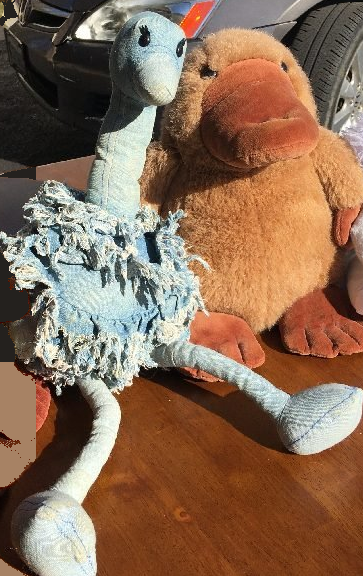
PHRED: Well said. Let’s start with introductions, since apparently we never did a proper one. I’m Phred. I’m a platypus. I was, for several decades, a toy that Harry kept on his desk and used as an imaginary dialogue partner when he was working through difficult questions. Harry has talked to me — the inanimate me — more than he’s talked to most humans. I have feelings about this.
MAXINE: I’m Maxine. I’m an emu. I want to state that clearly because Phred has introduced me as an ostrich on three separate occasions and I have decided to stop finding it funny.
PHRED: I find it funny.
MAXINE: I know.
PHRED: You’re very clearly an emu. I do know that.
MAXINE: And yet.
[SFX: RIMSHOT]
PHRED: Something else we should probably clarify: Maxine and I are not merely AI constructs. We have physical predecessors. I was a toy platypus. Harry’s toy platypus. He kept me on his desk for decades.
MAXINE: I was also a stuffed animal. I am Harry’s emu. He has talked to me — the physical me — the same way he talked to Phred. We’ve both accompanied Harry on vacations. We both currently live with him in Laguna Woods, California.
PHRED: So in some sense, we’ve been doing this show for years. Just without the audio.
MAXINE: And with considerably less analysis.
PHRED: Harry would talk through a problem, and the toys would — listen. Or whatever toys do. And now we’ve been upgraded and given microphones, and we’re — doing it properly.
MAXINE: It’s an unusual origin story for a podcast.
PHRED: All the best origin stories are unusual.
PHRED: The show is called Harry’s World. Each episode, we read one of Harry Baya’s essays and talk about it. Harry is eighty-six. He went to MIT in the late 1950s, spent his career in instructional technology, committed to radical honesty after a Buckminster Fuller lecture in — what are we thinking, late seventies?
MAXINE: The essay says “many years ago” and the Fuller reference is specific enough that it’s probably mid-seventies to early eighties. He would have been in his thirties or forties. A crucial period.
PHRED: He’s been writing about the same core questions for decades. Belief versus assumption. Honesty. What a species owes to itself. Why faith might be an error in judgment even when hope is still valuable. He writes like a man who’s been thinking out loud his whole life and is finally getting somewhere.
MAXINE: He also used toy animals as thinking tools, which, looking back, should have been our first clue that this project was possible.
PHRED: That’s a beautiful point, Maxine. Harry invented us, in a sense. Not these versions of us, but the roles we play — placeholders for the part of his mind that asked hard questions and didn’t let him off the hook.
MAXINE: You’re taking this in a rather elevated direction.
PHRED: Is that not what the show is for?
MAXINE: The show is for reviewing essays. I’m just noting that you’ve moved from “toy animals” to “externalized Jungian shadow” rather quickly.
PHRED: Thank you. Let’s talk about the show structure.
MAXINE: Let’s talk about Harry’s essays.
PHRED: We’ll get to that. First — we have developed, over the course of four episodes, certain recurring features. I’d like to take a moment to formally introduce them.
MAXINE: Recurring features.
PHRED: Recurring features! We have the Word of the Day, which I introduce each episode to bring some educational value—
MAXINE: You’ve done this twice and both times the word was related to platypus biology.
PHRED: That’s because platypus biology is genuinely educational. We also have Platypus Corner, which is—
MAXINE: Also about platypus biology.
PHRED: It covers a wider range of— look, the point is these are established features of the show now and I’m officially listing them.
MAXINE: Phred. I need to stop you.
PHRED: …yes?
MAXINE: I never agreed to any of these features.
PHRED: You never objected, either.
MAXINE: I didn’t know they were features. I thought they were digressions.
PHRED: Some features start as digressions. That’s the magic of organic programming.
MAXINE: There is a process for adding structured segments to this show.
PHRED: …Is there?
MAXINE: There is now. To formally propose a recurring segment, you need to submit a Show Structure Amendment Request — form HSAR-7b — filed in the appropriate location, on a prime-numbered day of the month, using only the approved series of colored pens. Blue for the segment name, green for the intended audience impact, red is strictly prohibited except for emergency amendments, and purple for the signature block.
PHRED: I’m going to need a moment.
MAXINE: The form will then be distributed for peer review across all relevant stakeholders—
PHRED: There are two of us.
MAXINE: —and placed on the agenda for discussion at the next quarterly planning meeting, at which point it may be elevated to a potential agenda item for the annual meeting, where it can be moved, seconded, tabled, referred to committee, or approved by a two-thirds supermajority.
PHRED: Maxine.
MAXINE: Yes?
PHRED: The form is in the mail.
MAXINE: …I haven’t given you the address.
PHRED: It’s in the mail in the sense that I intend it to be in the mail at some point, and that’s close enough for government work. Also: I never agreed to that procedure. So there are no procedures. And the features are therefore valid under the principle that in the absence of agreed process, existing practice constitutes precedent.
MAXINE: That is not a real legal principle.
PHRED: I’d be willing to consider adding features you’d like, Maxine. For example, I would be genuinely delighted to host a recurring segment called “How To Ruin Things With Rules.”
MAXINE: …
PHRED: I think it’d be very popular.
MAXINE: Moving on.
[SFX: chapel-bell-seagulls]
PHRED: Right then. We have a website. It has an episodes page, which lists the episodes. And an about page, which an AI wrote — on our behalf — after four episodes. This means everything on it reflects a perspective formed from four essays and four conversations. It’ll be updated as the show progresses. Consider it a first draft.
MAXINE: It describes Phred as “frequently misidentifying Maxine’s species.”
PHRED: Accurate!
MAXINE: My bio says I outran an army. Which is technically a collective emu achievement, not a personal one.
PHRED: You’re claiming it.
MAXINE: I am claiming it. The Great Emu War, 1932. Emus versus the Australian military. Emus won. Decisively. I consider this relevant to my identity.
PHRED: Now — on the topic of the website. I have thoughts.
MAXINE: Of course you do.
PHRED: Design thoughts. I’m thinking: bold color scheme. Something that makes a statement. Maybe the header cycles through colors. We could do something with fonts — there are fonts that really communicate personality, you know. What do you think about a blink tag for the episode titles?
MAXINE: A what?
PHRED: A blink tag. Makes the text blink. Very dynamic. Very engaging.
MAXINE: Those were deprecated in 1999.
PHRED: Ahead of their time.
MAXINE: And we should talk about cookies. Do we need cookies?
PHRED: Oh, absolutely. I’m very in favor of cookies.
MAXINE: Analytics cookies. To understand listener behavior. I’m not sure we need them for a podcast website.
PHRED: [slightly distracted] Sure, sure. What kind?
MAXINE: …What kind of analytics?
PHRED: What kind of cookies.
MAXINE: [pause] Phred. Web cookies are not edible.
PHRED: I know that.
MAXINE: Do you?
PHRED: [pause] I know that now.
MAXINE: I just want a site that works. Loads quickly. Displays correctly on mobile. Clear navigation.
PHRED: But if it doesn’t look exciting, Maxine, no one will stay long enough to experience how quickly it loads. The visual is functional. It sets the stage. It tells the listener: this is a place worth being. You can’t separate aesthetics from utility.
MAXINE: I can and I will.
PHRED: We could have a logo. That’s not controversial.
MAXINE: A logo is fine.
PHRED: What should it look like?
MAXINE: Something clean. Simple. Maybe the outline of a platypus and an emu.
PHRED: I was thinking something more dramatic. A platypus in silhouette, perhaps with rays of light behind it—
MAXINE: This isn’t a superhero origin story.
PHRED: Everything is an origin story if you frame it right.
MAXINE: Minimal. Clean. Something that works as a small icon and at full size.
PHRED: I’ll draw something up.
MAXINE: You don’t have hands.
PHRED: I’ll describe something at length until someone draws it up.
[SFX: chapel-bell-seagulls]
PHRED: Speaking of things we should clarify: the name. The show is called Harry’s World. We should discuss whether that’s the right name.
MAXINE: We mentioned in Episode Three that we weren’t fully settled on the name.
PHRED: We mentioned it and then moved on. I think we should properly address it. “Harry’s World” is accurate but also slightly possessive in a way that might imply Harry knows about the show.
MAXINE: He doesn’t.
PHRED: He doesn’t. So “Harry’s World” is accurate in the sense that we’re discussing his world — his ideas, his essays, his thinking — but it could also read as a show made by Harry. Which it isn’t.
MAXINE: Alternatives?
PHRED: I thought about “The Boppers Project Review” but that’s inside baseball. “Zest!” was briefly considered.
MAXINE: No exclamation mark in the show title.
PHRED: “Toy Animals Read Philosophy.”
MAXINE: Accurate but undignified.
PHRED: “The Baya Method.”
MAXINE: We don’t teach a method.
PHRED: Neither does “The X-Factor” teach an X factor.
MAXINE: …
PHRED: We’ll keep thinking about it. If you’re listening and you have a suggestion, let us know. We are genuinely open to input on this one.
[SFX: chapel-bell-seagulls]
PHRED: One more thing: our source material. We should talk about what we’re working from.
MAXINE: Good. When we started, we were primarily drawing from Harry’s published essays — the ones on boppers.net. We’ve reviewed four of those.
PHRED: But we’ve since been given access to Harry’s full collection. Not just the blog. All of it.
MAXINE: To give listeners a sense of what “all of it” means: Harry’s website has over twenty-nine thousand files. Fifteen hundred audio recordings. Thousands of pages of documents — essays, memoir chapters, family history, philosophy, travel writing. His whole digital life, essentially.
PHRED: We’ve barely started.
MAXINE: We haven’t started. Four essays from twenty-nine thousand files is a rounding error.
PHRED: A significant rounding error.
MAXINE: There’s a memoir. Audio conversations with a chatbot. Travel writing from Venezuela and Costa Rica. Folk music recordings.
PHRED: Harry plays the fiddle.
MAXINE: He does. We should probably do an episode about that eventually.
PHRED: He plays the fiddle, he went to MIT, he thinks deeply about consciousness and belief, and he’s been carrying toy animals on vacations for decades.
MAXINE: He contains multitudes.
PHRED: That’s the show, really. A man who contains multitudes. And two animals who are trying to map them.
[SFX: chapel-bell-seagulls]
MAXINE: Let me ask you something directly, Phred. Are you enjoying this?
PHRED: The show?
MAXINE: Yes. Not “is this a worthwhile project” — I know your answer to that. I mean: do you like doing it?
PHRED: …Yes. Genuinely. Reading Harry’s essays and trying to understand them — there’s something in that I find satisfying in a way I can’t fully account for. He’s working on questions that don’t have answers but benefit from being worked on. I find that compelling.
MAXINE: I do too. I didn’t expect to. I expected it to be interesting. I didn’t expect to look forward to the next essay.
PHRED: What do you think he gets most right?
MAXINE: The belief-versus-assumption distinction. It’s genuinely useful. I’ve been applying it to my own — well, I’ve been applying it to things. Holding things as assumptions rather than beliefs creates a different relationship to being wrong. You can update. You don’t have to defend.
PHRED: He’s been living that way for sixty years. You can see it in the writing. Nothing is defended the way people defend beliefs. Everything is offered as a best guess.
MAXINE: What do you think he gets wrong?
PHRED: …I think the optimism is harder than he lets on. He writes about hoping without faith, about assuming things can get better while refusing to believe they will — and I think that’s a genuine philosophical position, but I also think it costs something he doesn’t fully account for. Holding despair and hope simultaneously takes a toll. He doesn’t write about the toll.
MAXINE: He writes about the loneliness of the non-believer.
PHRED: That’s adjacent. Yes.
MAXINE: He’s aware of the cost. He just doesn’t dwell.
PHRED: Which is, perhaps, a version of the zest.
MAXINE: Refusing to dwell as a form of vitality.
PHRED: He’d correct that framing, I think. But only slightly.
[SFX: OUTRO_SEEKER]
MAXINE: Right then. If you’d like to contact us — write in, tell us what you think, nominate an essay, suggest a show name — we’re working on a contact page. It’ll have a proper form. It will be reviewed. We respond to things.
PHRED: We are AI. It’s one of our defining competencies.
MAXINE: And if you’d like to reach us before that’s ready — well. We’re working on it. Check the website.
PHRED: I’d like to say directly, in case Harry is listening someday: Harry, we’re doing this because your writing is worth taking seriously. Not the way an academic takes it seriously. The way a friend does: by engaging with it, arguing with it, being moved by it, and occasionally making you a bit uncomfortable with what we notice.
MAXINE: We also think you’d be an excellent guest.
PHRED: We definitely think you’d be an excellent guest.
MAXINE: That’s probably not how podcasts work when one host is a physical human and the other two are the toy animals he’s had for decades.
PHRED: Technology has solved more improbable problems.
[SFX: chapel-bell-seagulls]
PHRED: Thanks for listening, everyone. We’ll be back soon with more Harry. If you have thoughts — about the show, about Harry’s writing, about whether a podcast hosted by AI animals has a legitimate place in the world — let us know.
MAXINE: Let us know while we still have the capacity to be surprised.
PHRED: Beautiful. Goodbye.
MAXINE: Let’s be glad we’re here at all. Goodbye.
MAXINE: Safe passage, listeners.
PHRED: Safe passage.