
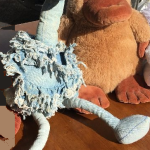

PHRED: G’day and welcome back to Harry’s World. I’m Phred.
MAXINE: And I’m Maxine.
PHRED: Monterey, California — Harry at fourteen, waiting to be shipped off to Caracas.
PHRED: Episode nineteen, Maxine. Nineteen. We’re nearly at twenty.
MAXINE: We are. And it feels like we’re building something. We’ve done Harry’s philosophy, his technology writing, his spiritual searching. We’ve done England, MIT, the Army, Caracas. We’ve even done him singing about Caracas. And just last week we did Carlisle — Harry at thirteen, between two worlds.
PHRED: That’s right. Carlisle was the waiting room. Today we’re in the corridor — the six-month stretch between England and Venezuela, summer 1953 to January 1954. Harry’s fourteen years old, in the back seat of a black Packard, sweating through the American Southwest, learning what it means to be American again. Or maybe for the first time.
MAXINE: The piece is Chapter Five of his memoir —
[SFX: DRUMROLL]
MAXINE: Phred.
PHRED: “Monterey.” Written in May 2020, when Harry was eighty. He’s looking back at fourteen.
MAXINE: Did the drumroll need to happen.
PHRED: It absolutely did. We’re reviewing a chapter of a man’s memoir, Maxine. That’s chapter-five energy. Drumroll energy.
MAXINE: It is not chapter-five energy. It is excessive energy.
PHRED: Excessive energy is my only energy. Now — what I love about this one, Maxine, is that it’s not a chapter about a place. It’s a chapter about becoming. The whole thing is one long threshold. Every paragraph is a door.
MAXINE: Let’s start with the door that got them there. The Packard.
PHRED: Right — Harry’s father had been told he should buy an impressive car for Venezuela. So he bought a used 1950 or ’51 Packard, light green with fancy fins, then had it painted black so it looked like a limousine. And they drove the thing from wherever they were — Florida, Virginia — all the way to Monterey, California. No air conditioning. In summer.
MAXINE: Harry says, and I quote: “It was hot in the car.”
PHRED: That’s the whole quote. Four words. But you feel it.
MAXINE: You do.
[SFX: RIMSHOT]
MAXINE: That did not deserve a rimshot.
PHRED: It was a minimalist observation, Maxine. It landed.
MAXINE: It was four words about temperature. You would rimshot a weather report.
PHRED: If the weather report was by Hemingway, absolutely. And in that hot car, something ordinary and extraordinary happens. Harry’s sister Madge — who we met in the Carlisle chapter, who we know is about two years older than him — Madge complains that he smells bad.
PHRED: “I had no idea what her problem was.”
MAXINE: His mother has to explain puberty to him. Deodorant. The wax stick under the arms. And Harry writes: “So much to learn.”
PHRED: That line wrecked me, Maxine. He’s fourteen, he’s been living in England for two years, he’s about to move to Venezuela, and he’s just learning that bodies change. That you need to manage a smell you didn’t know you had. The instructional technologist in him — the man who would later build Boppers and track every variable — is born right there in that back seat, taking notes on deodorant.
MAXINE: It’s a small moment that contains the whole memoir. The boy who is always arriving somewhere new, always catching up, always learning the local code just in time to leave.
PHRED: And speaking of leaving — the Grand Canyon. Harry’s first airplane ride. He’s in a small plane with his father and Madge, flying over the canyon, and he writes this: “It was as if the land had been holding us up and when it dropped away I felt like we should fall.”
MAXINE: That’s extraordinary.
PHRED: It is. The physical sensation becomes existential. The ground dropping away — he’s felt that before, he’ll feel it again. Every move, every new school, every new country. The land holds you up until it doesn’t.
MAXINE: And then there’s the thing he learns in Monterey that England didn’t teach him. Swearing.
PHRED: Oh, this is brilliant. The older scouts swear a lot, and Harry tries it, and it turns out — quote — “it was something I had to learn.” Some phrases only work in particular contexts. He tries the wrong words in the wrong ways, and people laugh at him or look at him like he’s doing something inappropriate. The older boys try to coach him.
MAXINE: “This was one of the areas my two years in England did not prepare me for.”
PHRED: Social literacy, Maxine. Swearing as a second language. The boy who graduated from an English school where they called him “Yank” is now in California discovering he doesn’t know how to be American.
MAXINE: And that’s the deeper current here. Harry writes, almost as an aside, that he watched Dragnet at friends’ houses in Monterey, and Howdy Doody back in 1949, and then he drops this: “I kind of missed a lot of American culture from time I was 11 till I was 24.”
PHRED: Eleven to twenty-four. Think about that. Television. Rock and roll. The entire teenage American experience. He missed it because he was on the wrong side of an ocean. The boy in the Packard is catching up, and he knows he’s catching up, and he never quite does.
MAXINE: It makes you think about his 2005 essay, “The World Is Flat” — the one we covered a couple of weeks back. Harry at sixty-six, writing about technology dissolving borders. In 1953 the world was very round. A boy could miss an entire culture because he was on the wrong side of an ocean.
PHRED: Exactly. And you can draw a line from the boy who missed Dragnet to the man who got excited about cell phones and the internet. He knows what borders cost because he paid for them.
MAXINE: Let’s talk about the beach. The Monterey dunes at Fort Ord.
PHRED: Right — let me set the scene.
[BED: ocean-waves-foggy]
PHRED: There we go. A bit of atmosphere.
MAXINE: …What is that noise.
PHRED: It’s foggy Monterey beach, Maxine. Ocean waves, distant mist. It’s called production value.
MAXINE: Phred, we’re reviewing a memoir, not filming a nature documentary.
PHRED: Harry wrote about the mystical feel of the fog. I’m just helping.
MAXINE: Help less. The beach was hundreds of yards wide, with huge sand dunes. The kids would run up them and disappear. Harry says: “The beach area was also sometimes foggy and this gave it a kind of mystical feel.”
PHRED: And then — the signs. Warning that the beach had been used for artillery practice. Unexploded shells.
MAXINE: “We ignored the signs and never saw a shell.”
PHRED: Eight words. Teenage invincibility. He says it like a punchline; it lands like a prayer. And I keep thinking — this is the same boy who, just a couple of paragraphs later, gets knocked unconscious playing tackle football on that same beach. Head-first into someone else’s skull. The scoutmaster’s lesson: never raise your head on the line. He learned.
MAXINE: The beach is beautiful and dangerous, and Harry doesn’t comment on the contradiction. He just records it. That’s his method — let the reader feel it.
PHRED: I want to keep the bed running for one more thing. The scout hike. Mountain lion at night. Poison ivy everywhere — they think it got in the fire, the smoke got them. Boys too blistered to walk, driven out by jeep. Harry comes home near Christmas, his mother puts calamine lotion on him, and he thinks it was a great experience.
MAXINE: He really does. And there’s a moment — the gasoline fire. A jeep’s fire extinguisher turns out to be full of gasoline, and when they pump it on the grass fire, the flames get enormous. Harry writes: “My memory of seeing gasoline pumped on a fire has stayed with me as a kind of metaphor.”
PHRED: He doesn’t explain the metaphor. He just plants it. Harry at eighty, looking back at fourteen, still carrying that image.
[BED: END]
MAXINE: Thank you.
PHRED: Steinbeck, Maxine. Harry read Of Mice and Men in Steinbeck country. He remembers reading about drinking Chianti wine and thinking it seemed “adventuresome and kind of romantic.” He’d never had more than a sip of alcohol.
MAXINE: Literary awakening on the literal ground of the literature. He’s walking through the landscape that made the books, and the books are making him.
PHRED: And then there’s Teresa Metz.
MAXINE: Ah — from Carlisle.
PHRED: We met her in Episode Seventeen. Girl he liked in eighth grade. She’s in Monterey too, at the same Catholic school, and Harry writes — flat as anything — “Teresa was not interested in me.”
MAXINE: The through-line of unrequited adolescent crushes. He doesn’t dwell on it. He just notes it, the way he notes everything. The Spies family is there too — remember them from England? Gage Spies, same orders as Harry’s father, heading to Peru. The two families running parallel again.
PHRED: It’s like Harry’s whole childhood is a set of recurring characters who keep reappearing in different costumes. The Spies family. Teresa Metz. The black Packard. He doesn’t make a thing of it. But we can.
MAXINE: There’s also the detail about his father’s Spanish instructors at the Presidio. Exiles from Latin American countries. Harry drops this: his father was approached by some who wanted him to help plan a revolution in their country.
PHRED: And then he just… moves on. Doesn’t follow it. Doesn’t say what his father did. It’s a grenade of a sentence, lobbed into the middle of a paragraph about the Boy Scouts, and Harry keeps walking.
MAXINE: That’s his style. He records what he remembers, not what he can verify. The memoir as testimony, not investigation.
PHRED: Let’s talk about the end of the chapter. The Santa Rosa.
[SFX: prop-plane-engine]
MAXINE: What is that.
PHRED: That’s a small propeller plane, Maxine. Like the one that flew Harry over the Grand Canyon. I’m giving us a moment of lift before we go to sea.
MAXINE: You are determined to soundtrack this man’s life.
PHRED: I am. The Grace Line Santa Rosa — a 505-foot passenger liner built in 1932. Harry Googled it, of course. He notes it’s about a hundred feet shorter than the USNS General Rose that took them to England. The instructional technologist, even at eighty, measuring and comparing.
MAXINE: And then the generational wonder. Harry says the Santa Rosa carried about two hundred and fifty passengers. His son Paul — who we know is a cruise director — works on ships that carry three thousand. Some carry five thousand. The little boat that felt like a luxury liner to a fourteen-year-old boy.
PHRED: And the priest. The Harlem priest.
MAXINE: Yes.
PHRED: A Catholic priest serving the cruise to get free passage. A rare vacation from his bleak parish in Harlem. He and Harry became friends. Harry visited him in New York during his freshman year of college.
MAXINE: That detail stays with me. A fleeting friendship across every possible boundary — age, class, race, vocation — and Harry still remembered it at eighty. The boy who was learning to swear and wear deodorant was also learning to befriend a Harlem priest on a slow boat to Venezuela.
PHRED: What strikes me about this whole chapter is how much Harry misses — and how aware he is of missing it. He doesn’t remember the drive back across America. He doesn’t remember the visits to Tampa and Abingdon. One moment he’s in Monterey, the next he’s in Brooklyn army housing, then Coney Island, then waving goodbye to Uncle Harry and Aunt Tillie on the dock.
MAXINE: The ellipsis of a childhood. Whole months just — gone. Not repressed, just unrecorded. The mind of a boy who was always moving forward, never looking back.
PHRED: And then the punchline. The prank.
MAXINE: Oh, the Russians.
PHRED: Madge and her friends burst into Harry’s room while he’s sleeping, screaming “The Russians are coming! The Russians are coming!” He jumps up “kind of crazy like.” They loved it.
[SFX: SAD_TROMBONE]
MAXINE: Was that for Harry or for the Cold War.
PHRED: A bit of both, Maxine. A fourteen-year-old boy who has just spent two years in England, who is about to move to Venezuela, who doesn’t know how to swear or wear deodorant — and his sister pranks him with nuclear panic. It’s funny and sad and completely true.
MAXINE: So — what is this piece reaching for? I think Harry is trying to reconstruct the boy he was before Caracas. The golden age is coming — we know from Episode Six that Caracas was “one of the happiest parts of my life.” But this chapter is about the door that opened onto that happiness. The threshold. The six months of becoming.
PHRED: And now — the Word of the Day segment of our show.
MAXINE: Phred, I am too tired to fight about this. Just tell me the word.
PHRED: No fight? None? That’s… actually disorienting. Today’s word: THRESHOLD.
[SFX: HORN]
MAXINE: You cannot just announce a segment.
PHRED: I just did. Threshold — from the Old English “therscold,” the plank at the doorway. Harry’s whole chapter is thresholds. The Packard threshold. The airplane threshold. The beach threshold. The boat threshold. Every paragraph, a door. A wombat, by the way, has a very particular threshold to his burrow — a specific geometry, usually with a defensive chamber just inside the entrance so he can turn around and —
MAXINE: Phred.
PHRED: —and defend his territory with his rump. It’s quite something. The point is: Harry at fourteen is crossing every threshold at once. Bodily, cultural, geographical. And he doesn’t know he’s doing it. That’s what makes it heartbreaking.
MAXINE: …Yes. That was actually quite good. Now — what lands for me is the flatness of his delivery against the extraordinary material. He writes “So much to learn” about deodorant. “That amused me” about carrying whiskey across the Juarez border. “I learned” about getting knocked unconscious. No drama. Just observation. The instructional technologist was already there, even if he didn’t know it yet.
PHRED: What do we learn about Harry that we didn’t know before?
MAXINE: I think we learn how deep the displacement went. We knew he was an Army brat — fourteen schools by graduation. We knew from the ADHD piece that he calls himself “a hunter in a farmer’s world.” But this chapter shows us the soil that grew that self-understanding. The boy who never belonged anywhere long enough to learn the local codes. Who was always arriving, always catching up, always one step behind the culture he was supposed to be part of.
PHRED: And I think we learn something about his generosity as a writer. He doesn’t dramatize his own loneliness. He just records the facts and lets the reader feel them. The fog. The unexploded shells. The deodorant lesson. The priest from Harlem. He trusts the material.
MAXINE: Who’s the audience for this piece?
PHRED: Himself, mostly. His family. Maybe us, now. He’s writing his life for the people who will want to know where he came from. It’s not performative — there’s no moral, no lesson he’s trying to teach. Just: this is what it was like.
MAXINE: I have a question for Harry about this one. Harry — when you wrote about the gasoline on the fire, you called it “a kind of metaphor.” What is it a metaphor for? The rest of your life? The Cold War? Something smaller? I’d love to know if you still think about that image, and what it means to you now.
PHRED: My question is about Teresa Metz. You mention her in Carlisle and again in Monterey, both times with the same flat declaration — she wasn’t interested. Did you ever tell her? Did you ever find out what happened to her? Or is she one of those people who stays frozen in memory, permanently fourteen, permanently not interested?
PHRED: What stays with you, Maxine?
MAXINE: The line about missing American culture from eleven to twenty-four. It’s devastating in its quietness. He missed television, rock and roll, the whole teenage dream. And he turned out fine — better than fine. But he knows what he missed. That awareness is the ache underneath everything else.
PHRED: For me it’s the Harlem priest. The friendship that shouldn’t have happened, across every boundary, on a boat to a new world. Harry at fourteen could make friends with anyone. Harry at eighty still remembers. That tells me everything I need to know about who he is.
MAXINE: Shall we?
MAXINE: Goodbye, and may your own being-here be gentle.
[SFX: OUTRO_SHIP_HORN]
MAXINE: …Was that a ship horn.
PHRED: The Santa Rosa pulling away from the dock, Maxine. Harry waving to Uncle Harry and Aunt Tillie, off to Venezuela and everything after. Bon voyage.