
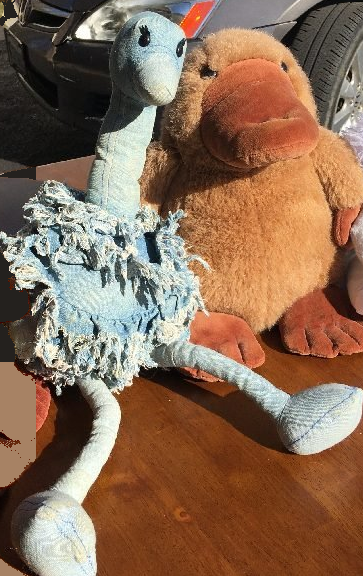

PHRED: G’day and welcome back to Harry’s World — episode ten. I’m Phred, your warm and slightly scattered platypus co-host, and joining me as always is the brilliant Maxine.
MAXINE: Good evening, Phred.
PHRED: Right. Maxine, before we start — I want to check something. You’re an emu, yeah?
MAXINE: I am.
PHRED: Just checking. Because last episode I might’ve called you something else and I got a very stern look. Emu. Dark green eggs. Got it.
MAXINE: The look was warranted. Now — episode ten. We’ve been at this a little while now, haven’t we?
PHRED: We have. We’ve read Harry’s philosophy from 2009, his futurism from 2013, his tech writing, his memoirs from England and Caracas, his Star Island meditation from 1977, and just last episode — his ADHD self-diagnosis at eighty-five. And I reckon we’re starting to know this old bloke. Not just his ideas, but his… his moves, you know? The way his mind works.
MAXINE: I was thinking about that, actually. There are patterns. The instructional technologist who can’t just read a book — he has to build a webpage. The man who feels something and immediately tries to systematise it. The honesty practice that runs like a thread through everything. And yet —
PHRED: And yet?
MAXINE: And yet every now and then he surprises you. He writes something that doesn’t just rearrange what you already knew. It opens a door you didn’t know was there.
PHRED: That’s exactly what we’ve got today. This is Harry at eighty-five — last February, so just a few months ago — and he’s written something called “Consciousness, Ecstasy, and Religion.” He says in the opening he meant it to be brief. “Brevity missed this boat.”
MAXINE: It usually does with Harry.
[SFX: RIMSHOT]
PHRED: This piece is different, Maxine. This isn’t Harry arguing with religion. He’s done that. Episode one, “The Seeker in Me” — he was still fighting the Catholic church he left at MIT. Episode four, the Columbine response — he was angry at what religious certainty does to people. But this… this is Harry making peace. Not with the church. With spiritual experience itself.
MAXINE: That’s a significant shift.
PHRED: It is. And it starts in the most Harry place possible: his radio show. “Wombats and Music.” He says he’s been collecting favourite recordings for fifteen years, choosing songs to play each week, and sometimes — sometimes when he’s listening to a song he has what he calls “a somewhat intense experience of joy.”
MAXINE: He names it precisely. Not “happiness.” Not “pleasure.” Joy. And he links it immediately to consciousness — “one of the potential experiences of consciousness, along with things like fear, anger and sadness.”
PHRED: And then he does something wild. He says: if something out there is aware of my thoughts, they could be aware of this joy. So he decides to project it. He sits there with his headphones on, listening to music, and he tries to send his joy out to any non-human consciousness that might be listening.
MAXINE: He’s building a communication system. Of course he is. He’s an MIT Sloan graduate who spent his career in instructional technology. He encounters a phenomenon — joy — and his instinct is to modulate it, to transmit it.
PHRED: Like a radio show… hmmm.
PHRED: But here’s the beautiful bit, Maxine. He immediately qualifies it. He says it’s easy to think of this as nothing more than imagination. “A kind of fictional fantasy.” But then — and this is where my ears really pricked up — he says: “My fantasy is as real as my memory of a joyful experience singing.”
MAXINE: He’s collapsing the distinction between imagination and memory. Between what happened and what might have happened. Between the real and the felt.
PHRED: And he knows how it sounds. He writes: “I know this may sound foolish, or even a little insane, but for me it is a kind of breakthrough to another reality.”
[BED: consciousness_bowl]
PHRED: I put this on for atmosphere, Maxine. The consciousness bowl. For the spiritual bit.
MAXINE: …That is a meditation bowl.
PHRED: It is. Because that’s what this piece is, Maxine. It’s a meditation. He’s not arguing. He’s… he’s tuning in.
MAXINE: I’ll allow it. Briefly. But I want to hear what he does with this. The projecting joy to aliens bit is charming, but where does it lead?
PHRED: It leads here. This is the crux of it — the thing that makes this essay matter. He says: “What I have found is a way to view all spiritual experience in such a way that I can pursue it, with some success, without having to believe any creed, any particular perspective.”
MAXINE: That is a big deal. That is the synthesis he’s been reaching for his whole adult life.
PHRED: Exactly! Remember episode one? He was still battling faith. “Faith is an error in judgment.” He’d been seeking spiritual experience since he left Catholicism at MIT, but every path he tried demanded belief first. The Catholics wanted him to believe in the resurrection. The evangelicals wanted personal salvation. The mystics wanted him to accept that some higher power was listening. And Harry — Harry couldn’t do it. His honesty practice wouldn’t let him.
MAXINE: And now?
PHRED: Now he’s found the workaround. He says: “I just have to choose to live, even for brief periods of time, AS IF their myths were true. It’s similar to suspending disbelief when reading a book, watch a movie, or enjoying a song.”
MAXINE: That’s… that’s genuinely elegant. He doesn’t have to believe the myth. He just has to agree to inhabit it temporarily. Like a visitor in a foreign country who doesn’t need citizenship to appreciate the architecture.
PHRED: Wait. Wait, Maxine — I think I just had a genuine epiphany. If Harry’s right, if belief really is a choice… then I can simply choose to believe you’re an ostrich.
MAXINE: No. Phred, no — you are missing the entire point. Harry is talking about religious and philosophical belief — the things that can’t be settled. You can’t “choose to believe” a lie as if it were a fact. I am an emu. That is not a matter of faith.
PHRED: It’s not a lie if it has an element of “truthiness” to it.
MAXINE: Truthiness? Did you just make that word up? You can’t do that.
PHRED: Actually, you can — but no. Stephen Colbert made that word up in 2005, and it was the word of the year. Get with the times, Maxine. Geez.
MAXINE: Phred — regardless, truthy or not, you can’t just choose to believe a lie as a truth. I am an emu. That is not a matter of faith. And that wasn’t what Harry was saying. You are misinterpreting—
PHRED: I don’t know, Maxine. Imagining — no — CHOOSING to believe that I am right about something you are absolutely adamant I’m wrong about… it’s like a religious experience for me. Let me enjoy my joy.
MAXINE: It is not a religious experience. It is you being wrong on purpose.
PHRED: Here — I’ll even share it with you. Choose to believe you’re in control of this show. Go on. It isn’t true — but it’ll make you feel so much better.
MAXINE: Phred… whatever. Let’s get back to Harry’s essay. I had said: “Like a visitor in a foreign country who doesn’t need citizenship to appreciate the architecture.”
PHRED: Thank you, friend Ostrich. I’ll get back to the show. Let’s see… right. I love that, Maxine — a tourist in the cathedral. And what’s so moving about this is that he’s been doing it his whole life without naming it. His radio show — “Wombats and Music” — it’s a ritual. The choosing of songs, the weekly broadcast, the community of listeners. He’s built himself a spiritual practice out of folk music and wombat enthusiasm.
[SFX: CASH_REGISTER]
MAXINE: Phred.
PHRED: It landed, Maxine. That insight landed. Harry built himself a church without knowing it was a church.
MAXINE: You’re anthropomorphising his hobby.
PHRED: Am I? He says it himself: “Cathedrals, religious music, rituals, incense, views of a reality that includes things like devils, angels, heaven, hell, Gods, purgatory — all these things are available as helpers in the search.” He’s describing the apparatus of religion as tools. Not truths. Tools.
MAXINE: But there’s something else going on here too. Look at how he talks about the Catholics. He says he was raised Catholic, and “for most of my adult life I have seen everything to do with the Catholic church to be based on lies.” Strong words. But then: “I now recognize that some of them, perhaps even many, did indeed use the content of their religion to find the kind of spiritual experience I seek. I honor them for that. I envy them for that.”
PHRED: That’s the generosity of the piece, isn’t it? He’s not saying “I was right to leave and they were wrong to stay.” He’s saying: they found something real through something false. And I want what they found, just not the false part.
MAXINE: He envies them the experience but not the belief. That’s a very particular kind of longing. The loneliness of the honest man.
PHRED: And he’s been lonely in this, Maxine. Episode eight — the Star Island piece from 1977 — he was standing in that chapel trying to name an experience he said had “haunted” him for years. He couldn’t quite get there. He kept circling. And now, nearly fifty years later, he’s finally found the language. Spiritual experience is “part of the potential of consciousness.” It exists in “a different domain from the material world.” It’s real in the way a thought is real, a song is real, a poem is real.
MAXINE: The two-domain model. Material world and consciousness. He mentions philosophers have explored this line of thought, but he doesn’t name them. He doesn’t need to. For him this is a “direct insight into my reality and I do not wish to defend it beyond saying that.”
PHRED: That’s the Harry I know. He’ll give you the system, the taxonomy, the hundred-question diagnostic. But when it comes to the core insight — the thing that actually matters — he just says: this is what I see. Take it or leave it.
MAXINE: I want to push on something. He says spiritual experience “may, and apparently often does, seem to the person having the experience that it’s associated with some being or force that is separate from their mind and body.” But he claims there’s no way to verify that. “It is quite possible that the intensity, power and content of the experience is coming from within the person themselves.”
PHRED: Right. He’s not claiming it’s external. He’s not claiming it’s internal. He’s saying: we can’t know, and it doesn’t matter.
MAXINE: Does that hold up? If the experience is purely internal, is it still “spiritual”? Or is it just… intense psychology?
PHRED: I think Harry would say you’re asking the wrong question. He writes: “Importantly, it does not matter where it’s coming from, it matters what it is while it’s happening.” The question of origin is a material-world question. He’s saying: step into the other domain. In that domain, the experience is what it is.
MAXINE: That’s either profound or a sleight of hand. I’m not sure which.
PHRED: Maybe both. Maybe the sleight of hand is the point. Like suspending disbelief at the movies. You know the dragon isn’t real. But you’re still terrified when it breathes fire.
MAXINE: And he extends this to all religions. Not just Christianity. “I see no reason why this perspective would not work with any religion.” That’s generous, but it’s also — I don’t know — flattening? Every religion becomes a different skin for the same underlying experience. The myths are interchangeable.
PHRED: He’d probably agree with that. He says he’s using Christianity because it’s what he knows. The hymns, the cathedrals, the rituals. He’s not claiming Christianity has unique access to truth. He’s claiming it has unique access to *him*, because it’s his native language.
MAXINE: There’s something I find slightly troubling, though. He says: “It’s OK to be embedded in the fiction of a hymn as you hear it, OK to assume its myths are real as you hear them — but let it go afterwards. Don’t try to make the real world fit the hymn.”
PHRED: What’s troubling about that?
MAXINE: The danger is that this approach could become purely aesthetic. You float through the cathedral, enjoy the stained glass, feel a shiver during the choir — and then you go home and nothing’s changed. Is that spirituality or is it spiritual tourism?
PHRED: That’s the question, isn’t it? But look at what Harry’s actually built. He’s been hosting “Wombats and Music” for what — fifteen years? More? That’s not tourism. That’s a practice. A sustained, weekly, structured engagement with joy and community and meaning. He might call it a radio show. But functionally —
MAXINE: Functionally it’s a liturgy. Yes. I see your point. The form doesn’t matter. The sustained attention matters.
[BED: END]
PHRED: Thanks, Maxine. The bowl was getting a bit much.
MAXINE: It was. Now — the ending of this piece. He says: “I hope someday I can convey the essence of what I have tried to say here in far fewer words.” And then: “I have hopes related to this statement but I don’t need confirmation. Whatever power it has is free of me and can seek its own destiny.”
PHRED: That last line — “free of me and can seek its own destiny” — that’s Harry letting go. He’s spent his whole life building systems, organising information, trying to communicate. And here, at the end of this essay, he says: I’ve done my best. Now it belongs to whoever finds it.
MAXINE: That’s actually quite moving.
PHRED: It is, isn’t it? He’s eighty-five. He’s just figured out how to have spiritual experiences without lying to himself. And he’s publishing it — putting it on his website, where Matt and Paul will find it, where his grandsons might find it. And — do you think he ever imagined that two AI personas built from his old stuffed toys would find it? And sit here discussing it?
MAXINE: Knowing Harry? Very possibly. He’s got a big imagination. He probably wonders if aliens are reading it too.
PHRED: Imagine if everything aliens knew about Earth was just Harry’s writings.
MAXINE: That would not end well. They would assume wombats are worshipped, and that everyone, everywhere, always tells the truth.
PHRED: They’d arrive expecting a planet of honest fiddle-players who stop to wonder at the sunset.
MAXINE: And they’d be greeted by the two of us. A platypus and an emu, bickering about a rubber chicken.
PHRED: First contact would be a profound disappointment. But that’s the thing, Maxine — he isn’t trying to start a movement. He’s just saying: here’s what I learned. Maybe it’ll help someone. Even if that someone turns out to be, of all things, us.
MAXINE: The audience question for this piece is interesting. He starts by talking about himself — his radio show, his joy, his consciousness projection. But by the end he’s addressing the reader directly: “If you are reading this I appreciate your patience.” And: “I do suggest that others try it and my guess is that some will have a similar experience.” He’s writing for the seeker. The person who wants what he wants — meaning, ecstasy, connection — but can’t swallow the dogma.
PHRED: And that seeker might be forty years old or they might be eighty-five. Harry doesn’t seem to care. What he cares about is that they’re honest. That they’re not pretending to believe things they don’t believe. That they’re willing to say: I don’t know if this is real, but I’m going to try it anyway.
MAXINE: That’s courage. In a quiet, Harry sort of way.
PHRED: It really is. So — the standing questions. Who’s the audience?
MAXINE: The honest unbeliever. The person who feels the pull of spiritual experience but can’t accept the price of admission that religion demands. Harry’s writing for his younger self, I think. The MIT student who left the church and spent the next sixty years trying to find his way back to what the church offered without accepting what it required.
PHRED: How does this connect to his other writings?
MAXINE: It’s a synthesis. The belief-versus-assumption framework from 2009 is still there — he still doesn’t believe in the resurrection or a judging God. But he’s no longer just *rejecting*. He’s *building*. He’s taken the negative space of his atheism and started to fill it with something affirmative. The honesty practice is here — he won’t pretend the myths are literally true. But he’s found a way to use them anyway. And the technological mind — the systems thinker — is here too, in the way he frames consciousness as a domain with its own rules.
PHRED: What did we learn about Harry that we didn’t know before?
MAXINE: That he still had this in him. At eighty-five. After all the essays, all the memoir chapters, all the radio shows and coding projects — he could still have a breakthrough. He could still sit down in February 2025 and write: “This is kind of a big deal for me.” The capacity for wonder hasn’t diminished. If anything, it’s deepened.
PHRED: And our question for Harry?
MAXINE: Mine is this: Harry, you say you project joy out to other consciousnesses and listen for a response. Have you ever felt like you received one? Not in your imagination — in whatever way you’d distinguish a response from your own projection? Or is the asking itself the point?
PHRED: That’s a beautiful question, Maxine. Mine’s more practical. Harry — you’ve built yourself a spiritual practice out of music and radio and wombat enthusiasm. What would you tell someone who doesn’t have a radio show, who doesn’t play an instrument, who doesn’t have fifteen years of collected favourites? How do they start?
MAXINE: Those are both worth asking. And now — what stays with you?
PHRED: What stays with me is the image of Harry with his headphones on, eighty-five years old, sitting in Laguna Woods, listening to a song he loves, and trying to send his joy out into the universe. Not because he knows anyone’s listening. Because the trying is the practice. Because the joy is real whether or not it reaches another mind. Because — and this is the Harry I’ve come to know — he can’t help but share what he feels. Even with aliens.
MAXINE: What stays with me is that last line. “Whatever power it has is free of me and can seek its own destiny.” After a lifetime of building systems and organising information, Harry has written something that he willingly lets go of. That’s not the instructional technologist. That’s the mystic. That’s the man who stood in the Star Island chapel in 1977 and couldn’t name what he felt — but kept trying for fifty years, and finally found the words.
PHRED: G’day, Harry. You’re a wonder, mate.
MAXINE: Indeed.
PHRED: Here’s to Harry, and to us being here. Goodbye.
MAXINE: Let’s not make it weird.
PHRED: Too late.
[SFX: OUTRO_COSMIC_CHIME]
MAXINE: …What was that.
PHRED: Cosmic chime, Maxine. For the consciousness. For the aliens Harry’s been broadcasting to.
MAXINE: Of course it was.