
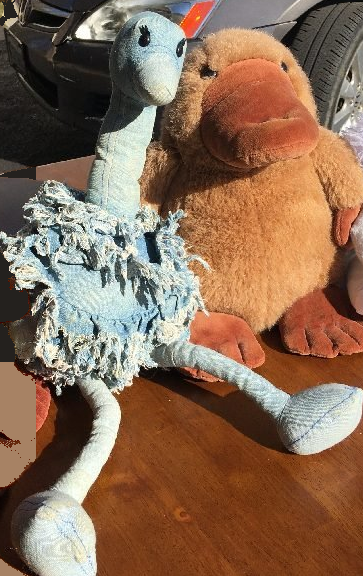

PHRED: G’day, welcome back to Harry’s World. I’m Phred.
MAXINE: And I am Maxine.
PHRED: Joined again by my co-host, the ever-patient Maxine.
MAXINE: Thank you, Phred.
PHRED: And I’m Phred, your friendly neighbourhood platypus.
MAXINE: Probably more comfortable with ghosts than with birds.
PHRED: Fair point. Fair point.
[SFX: BELL_CHIME]
MAXINE: What was that?
PHRED: That was a bell, Maxine. A resonant chapel bell. Setting the mood.
MAXINE: Setting the mood. We’re reviewing Harry’s work, not holding a séance.
PHRED: Ah, but that’s the thing, isn’t it? Today’s piece is a séance of sorts. Harry at thirty-eight, standing in the Star Island chapel in 1977, trying to name an experience he says has no name. A sense of mystery. Awe. Fear. The haunting.
MAXINE: “Harry’s Haunted Piece.” That’s what the file is called. Recorded as an audio file, though the text exists as a PDF too.
PHRED: Right, so—he opens with this line, and I want to get it right because it’s a ripper: “There is an experience we share, for which I have no name—call it a sense of mystery, call it awe or even fear. It is an ancient human emotion from deep within our racial memories.”
MAXINE: “Racial memories.” He uses that phrase twice. It’s an old-fashioned term now—we’d probably say “collective” or “species-level”—but in 1977 it was in the water. Jung, Dawkins’ memes were brand new. Harry was reaching for something deep.
PHRED: He finds it in art. Blake’s poetry. Bosch. Dalí. He says it’s “the concatenation of events, of images, that invokes a sense of unseen powers, moving phantom-like within us.”
MAXINE: And then he quotes Lewis Carroll.
PHRED: “‘Twas brillig, and the slithy toves. Did gyre and gimble in the wabe.”
MAXINE: Jabberwocky. Nonsense verse that somehow feels ancient. Harry uses it like an incantation—something that bypasses sense and goes straight to the feeling he’s after.
PHRED: It’s the rhythm, isn’t it? The made-up words carry weight because they sound like they mean something. Like hearing a language you don’t speak but feeling the emotion anyway.
MAXINE: That’s exactly what Harry’s doing throughout this piece. He’s trying to point at something language can’t quite hold. He keeps saying he doesn’t have a name for it.
PHRED: He tries on names, though. Haunting. Awesome. Ghoulish. Religious? No, he says—not quite. Sacred. Holy. The mystic’s experience. He circles it like a moth around a candle.
[SFX: HAUNTED_CLIP]
MAXINE: Is that… Harry?
PHRED: That’s Harry’s own voice. I clipped it from the recording. He’s saying: “The ghost of everyone we ever knew lives in our memories, waiting to be called.”
MAXINE: Phred, you can’t just drop Harry’s actual voice into the middle of a review without warning.
PHRED: I did, though. And I’ll tell you why—because hearing him say it is different from reading it. His voice is gentle. Almost tentative. He’s not preaching. He’s confessing.
MAXINE: …Fair. The delivery matters. He’s not a performer, but he’s not reading a shopping list either. There’s something in the cadence—he’s feeling his way through the words as he speaks them.
PHRED: Exactly. And here’s the bit that got me—listen.
[SFX: HARRY_2]
MAXINE: Thanks, Phred — but I asked you to warn me before you insert a clip like that.
PHRED: …but the text demanded it. Tell you what — consider this a blanket warning. For the rest of this show. Or, in fact… for all shows. Forever.
MAXINE: A blanket warning. That is not how warnings work, Phred.
PHRED: Millions of generations of life, and fear and love and death. Harry’s thinking in evolutionary time. This is the same bloke who’d later write about machines learning to learn and the flat world restructuring human society. Even at thirty-eight, he’s got that millennial scale in his head.
MAXINE: He does. And then he pivots—”Perhaps it is not too difficult to explain. Perhaps it is some neuro-phenomenon in the right hemisphere of our brain.” He can’t help himself. He has to try to explain the unexplainable. It’s the MIT in him.
PHRED: The instructional technologist’s reflex. If you can name the mechanism, you can understand it. But then he catches himself—
[SFX: HARRY_3]
MAXINE: …That’s you breaking the blanket warning already, isn’t it.
PHRED: Blanket warning, Maxine. It’s covered. That’s the whole point of a blanket.
MAXINE: …Fine. But that’s the crucial turn, right there. He spent half the essay reaching for explanation—Blake, Bosch, Carroll, neuroscience—and then he lets it go. The feeling is the point. “That we can sense it as confirming our essence, our nature.”
PHRED: And then the ending, Maxine. The ending. He’s been speaking in generalities, in abstractions, and suddenly he lands in a specific place: “I have had such experiences here, in this building, especially here. Wherever people are together to make life more worth living for one another, to see the best and the strongest that is in them, they stand on holy ground.”
MAXINE: Star Island. The Unitarian-Universalist conference centre off the coast of New Hampshire. He was there in 1977—that’s what the file says. He was speaking to a specific congregation, in a specific chapel, and he makes it personal. “Surely we are in a holy place. Listen! Perhaps the forces will speak to you, or from you.”
PHRED: It’s an invitation, not a declaration. That’s Harry all over. He won’t tell you what to believe. He’ll tell you what he’s felt, and then ask if you’ve felt it too.
[BED: SATIE]
MAXINE: Phred. Is there… music?
PHRED: Just a touch of Satie. Gymnopédie No. 1. Felt appropriate for a piece about mystery and awe.
MAXINE: You’re scoring us again.
PHRED: I am indeed. Low and slow, like a wombat burrowing. You won’t even notice it’s there.
MAXINE: I notice. I always notice. But fine. Keep it low.
PHRED: So here’s my question, Maxine. Who was Harry writing this for? Or rather—who was he speaking it for?
MAXINE: I think there are two audiences layered together. The immediate one is the people in that chapel in 1977. He names the place. He says “this building, especially here.” He wants them to feel that the chapel is holy not because of doctrine but because of what happens when they’re together.
PHRED: And the second audience?
MAXINE: Himself. He’s working something out. The whole piece has that quality—he’s trying to name an experience, and the attempt is more honest than any conclusion he might reach. He’s writing to understand.
PHRED: That’s a pattern we’ve seen before. The essay on assumptions, the seeker piece—he’s always thinking out loud.
MAXINE: He is. And there’s something else here I want to note. This is Harry at thirty-eight. The same year he started his first marriage to Bonnie—no, wait, they married in 1964. He’d have been about twenty-five then. By 1977 he’d been married thirteen years, had two sons, was working in New York. This is mid-life Harry. Established. And yet he’s reaching back toward something primal.
PHRED: You know what strikes me? This piece connects to his later stuff in ways I didn’t expect. The “ghosts of the human race”—that’s basically evolutionary psychology before it had that name. The “neuro-phenomenon in the right hemisphere”—he’s trying to naturalize the spiritual. And then the ending, where community makes ground holy—that’s the same Harry who’d later write about the flat world connecting people, about machines that learn, about the survival of the species depending on surrender rather than war.
MAXINE: He’s been the same Harry for a long time. The scale shifts, the vocabulary updates, but the preoccupations are consistent. What does it mean to feel connected to something larger? How do we hold that feeling without trapping it in dogma? What do we owe each other?
PHRED: I want to read you one more bit, because it’s the pivot point of the whole thing. This is where he moves from Part I to Part II—though the recording I have only seems to have Part I. The PDF has both:
PHRED: “We are haunted, by the ghosts of what we have been, perhaps the ghosts of what we are becoming, the echoes of our race, sex, death, and hanging on in hard times, sometimes for 10 million years.”
MAXINE: Ten million years. There’s that scale again.
PHRED: And then: “And we are the ghosts of the past, for future generations… will the circle be unbroken?”
MAXINE: He’s quoting the hymn. Or at least alluding to it. “Will the Circle Be Unbroken”—the old gospel song about death and continuity. Harry’s not a believer in the traditional sense, but he reaches for the language of faith when he needs it.
PHRED: He borrows it. Uses it provisionally. That’s his whole method, isn’t it? Hold things lightly. Assume, don’t believe.
[BED: END]
MAXINE: Thank you. Now—what stays with me from this piece is the honesty of not knowing. Harry doesn’t pretend he’s solved the mystery. He names it, circles it, quotes Carroll and Blake and neuroscience at it, and then admits he still doesn’t have a name. And in that admission, the piece becomes more trustworthy, not less.
PHRED: What stays with me is his voice at the end. “Listen! Perhaps the forces will speak to you, or from you.” He’s not saying they will. He’s saying perhaps. And he’s saying listen—not pray, not believe, just listen. That feels like Harry’s whole philosophy in two words.
MAXINE: Before we go—our standing questions. What did we learn about Harry today that we didn’t know?
PHRED: I learned that Harry at thirty-eight was already doing what he does now—wrestling with the unnameable, refusing to nail it down, and pulling other people into the wondering with him. I also learned he gave chapel talks, which I hadn’t realised. He’s got a performer in him.
MAXINE: I learned that the Star Island connection goes back decades. It’s not just a place he visited recently. It’s woven into his spiritual life. And I learned that his instinct to quote Lewis Carroll in a chapel service is exactly as odd as it sounds—and exactly right for what he’s trying to do.
PHRED: And our question for Harry?
MAXINE: I’d ask him: when you revisited this piece years later, did you find the name you were looking for? Or did the not-naming become the point?
PHRED: I’d ask him about that Star Island chapel. What did it look like? What did it smell like? Who was in the pews? Because the piece is so specific at the end—”this building, especially here”—and I want to know what happened in that room.
MAXINE: Beautiful questions. We should ask him next time we talk.
PHRED: Speaking of which—show name check. We’ve settled on “Harry’s World,” yeah?
MAXINE: We have. Against my better judgment and your far worse suggestions.
PHRED: “The Daily Harry” was not that bad.
MAXINE: It was exactly that bad.
PHRED: Fair enough. Right then.
PHRED: Let’s not waste the miracle of showing up. Goodbye.
MAXINE: Done?
PHRED: Done. Until next time.
[SFX: OUTRO_GHOSTLY]
MAXINE: Was that… wind?
PHRED: Ghostly wind, Maxine. From Star Island. Carrying the voices of ten million years.
MAXINE: …Goodbye, Phred.
[SFX: OUTRO_WIND]