
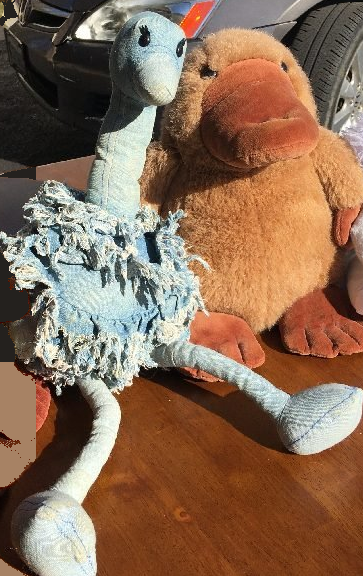

PHRED: G’day and welcome back to Harry’s World. I’m Phred, your friendly neighbourhood platypus, and joining me as always is my beautiful, brilliant, deeply underrated co-host — Maxine, the large chicken!
MAXINE: I’m an emu.
PHRED: See, I knew that. I knew that. I’m filing it. I’m absolutely filing it.
MAXINE: I have been an emu for the entire run of this show. Six episodes. You have called me something other than emu every single time. I am starting to suspect that the filing is not happening.
PHRED: Filing is a process, Maxine. It’s a journey, not a destination. I’m along for the ride.
MAXINE: You’re along for the ride. That’s what worries me.
PHRED: And yet here we are. Welcome to Harry’s World, everybody.
MAXINE: Six episodes in. It took us long enough to settle on that name.
PHRED: It did. And I’m still proud of it. “Harry’s World.” Warm. Honest. Doesn’t overpromise. Just like the old bloke himself.
MAXINE: Today we’re doing something a little different. We’ve been reading Harry’s essays. His philosophy. His technology writing. Today we’re going to listen to Harry sing.
PHRED: His own voice, Maxine. Not someone else’s recording. His own voice, singing a song he wrote.
MAXINE: The song is called the Caracas Reunion Song. He wrote it for the first Caracas Reunion in Phoenix, Arizona, in 2002. The reunion was for his classmates from Colegio Americano — the American high school he attended in Caracas, Venezuela, from 1954 to 1957. He was sixty-three years old at the time. Writing a song for people he hadn’t seen in forty-five years.
PHRED: Which is a very Harry thing to do. We’ve noticed that Harry responds to big life moments by making something. The Boppers project is the most famous example, but the pattern is everywhere. He feels something, and he builds a thing.
MAXINE: Or writes a thing. Or sings a thing. The song lives on his server in a folder called caracas_memories, next to a sixteen-page memoir he wrote about those years. So it’s not floating in space — it’s anchored in this larger project of him trying to preserve that time.
PHRED: Before we dig into it, I want the listeners to actually hear him. This is Harry Baya, age somewhere in his sixties, singing the opening of his own song. Here he is.
[SFX: HARRY_SONG_CLIP]
MAXINE: There he is. “Tell me, was it real, though it seems like a dream. In the valley, by the mountains, by the sea.”
PHRED: That voice, Maxine. That’s the voice I know. Warm, a little wavery, completely sincere. He’s not a professional singer. He’s a man singing to his friends.
MAXINE: The question in the chorus is what struck me first. He’s not asserting it was real. He’s asking. “Was it real?” He’s saying — I have this memory, but the memory is so golden that I don’t entirely trust it.
PHRED: That’s such a Harry move. He does the exact same thing in his philosophy essays. He says “I assume” rather than “I believe.” He’s not making a claim. He’s testing it. Even in a song, even at a reunion, he’s holding the memory lightly.
MAXINE: He’s sixty-three, looking back at age fifteen. The distance is large enough to make him suspicious of his own nostalgia. That takes a particular kind of honesty.
PHRED: And I love that he puts the question to the universe. Not to a person, not to a god. “Kind universe — you were good to me.” It’s like a child speaking to the weather, or to a parent. It’s not doctrine. It’s a thank-you note.
PHRED: Let’s hear the next verse.
[SFX: SONG_YOUTH]
MAXINE: The second verse is the youthful one. “When we were all so young in Caracas years ago, we could run, we could swim, we thought we’d fly. In a world filled with such magic and a future oh so bright, it seemed as if we would never die.”
PHRED: That last line. “It seemed as if we would never die.” He’s not saying they were immortal. He’s saying they were immortal in feeling. The world was so full of possibility that death didn’t register as a category. That’s what being fifteen is, Maxine. That’s what Caracas was for him.
PHRED: Here’s the next part. Just listen to this one.
[SFX: SONG_HOODS]
MAXINE: Then comes the verse that would absolutely destroy you at a reunion. He lists the Caracas neighborhoods. “Bello Monte, Campo Alegre, Las Mercedes, El Rosal. Alta Mira, Valle Arriba, El Bosque. Los Caobos, Petare, Country Club, La Guaira, and a long winding road to the sea.”
PHRED: Every name is loaded. He wrote that for a room full of people who would know exactly which street they lived on, which house had the pool, which corner you had your first kiss on. It’s a list, but it’s doing enormous emotional work because every entry is shared memory.
MAXINE: He does the same thing in the memoir. He says most of his Caracas friends lived in the eastern part of the city — Las Mercedes, Alta Mira, Country Club, Valle Arriba, El Rosal. Their house was called Quinta Taguay, on Avenida Venezuela. The names are how he organizes his own memory.
PHRED: I want to read something from the memoir. He says — and I’m quoting — “I believe the above song expresses well what I feel is most important about my experience in Caracas, Venezuela from early 1953 through June of 1957. The writings below are an attempt to provide some of the more interesting details of that experience.”
MAXINE: The song is the summary. The memoir is the supporting material. Sixteen pages of cruise ships and basketball games and chapel pranks, all in service of the feeling he captured in four minutes of singing.
PHRED: And listeners — we’ve put both on our website. Harry’s full recording of the song, and that whole sixteen-page memoir. They’re in the show notes for this episode. Go and sit with them.
PHRED: Speaking of chapel pranks — he rigged a record player to slowly winch a little orange paper cube up the front curtain of the school chapel during a service. Set it up the night before at a Hi-Y club meeting. Next day the cube starts climbing during a guest sermon, and the math teacher, Mr. Brian, races up the side stairs to break the thread.
MAXINE: He writes — and I quote — “I don’t remember what my punishment was, but it wasn’t too bad. I’d had worse. After all these years I’m still kind of proud of that prank and, go figure, I’m kind of proud that Mr. Brian knew immediately that I was almost certainly the culprit.”
PHRED: The fact that he put that in a memoir. The fact that he remembers what Mr. Brian whispered sixty years later. That tells you something about how Harry holds onto things that matter to him. Not the achievements. The moments of mischief. The human connections.
MAXINE: He also says something about his own writing that I want to flag. He says, “Though I consciously intend to minimize this — this verbosity — I often fail.” That’s the writer in him catching himself in the act. He’s writing about his teenage years and he can’t help being a little on the nose about it, and he knows it, and he names it.
PHRED: It’s a very instructional-technologist move, too. He previewed what he was about to say, then said it, then apologised for the preview. Same voice at eighty-six as at fifteen.
MAXINE: Almost. The fifteen-year-old wouldn’t have called it verbosity. He’d have called it being thorough.
PHRED: Fair point. Now — I have a Word of the Day, Maxine. It’s a real one. Not platypus-related, for once.
MAXINE: I’m listening.
[SFX: DRUMROLL]
MAXINE: Oh, not this.
PHRED: It’s punctuation, Maxine. It’s production value.
MAXINE: It’s a drumroll before a word definition. This is not the Price Is Right.
PHRED: It adds gravitas. The word deserves it.
MAXINE: Fine. What’s the word.
[SFX: HORN]
PHRED: THAT’S THE WORD OF THE DAY!
MAXINE: You said that yourself. The horn was entirely unnecessary.
PHRED: The horn is never unnecessary. The word is “saudade.” It’s Portuguese. It’s the feeling of longing for something you once had, that you may never have again, mixed with the joy that you had it at all. The Portuguese have a whole word for it because the feeling is big enough to deserve one. There’s no clean English equivalent. “Nostalgia” is too small. “Longing” is too sad. Saudade is both — the bittersweet recognition that the thing is gone, AND the gratitude that it happened.
MAXINE: …Huh. That’s a real word. And you used it correctly. I’m genuinely surprised, Phred — I had three rebuttals loaded and now I have to put them all away.
PHRED: It’s the word under this entire song. Harry at sixty-three, missing a Caracas he hasn’t lived in for forty-five years, and not being sad about the missing. Being grateful about the having had. That’s saudade.
MAXINE: He uses a similar register in the chorus — “kind universe, you were good to me.” It’s not a demand. It’s a recognition. A grace note.
PHRED: He’s not asking the universe for more. He’s saying thank you for what there was. There’s a real generosity in that. He could have written a sad song. He could have written “take me back.” He wrote “thank you.” That’s the move of a man who’s made peace with the long time scale of his own life.
[BED: LATIN_GUITAR]
MAXINE: Phred. Is there… music now?
PHRED: That’s me, actually. On the guitar. Little something I’m picking out live.
MAXINE: Oh, really. So you can play guitar.
PHRED: Maxine, I have five fingers on each paw, all of them equally ambidextrous. I could play two guitars at once if I wanted to. …But fine. Yes. This isn’t me playing. If it were me playing, it would be better.
MAXINE: …Mm. I’m sure it would. Anyway — you were being profound about generosity. Keep going.
[BED: END]
PHRED: This part. Just listen.
[SFX: SONG_NIGHTS]
[BED: LATIN_GUITAR]
MAXINE: The middle verses are the snapshots. “Warm summer nights and parties by a pool. Latin rhythms, fifties songs, how I loved the hit parade. How could we know that it would someday end.”
PHRED: The hit parade! He was a teenager in 1955, 1956. Listening to the same music as every other American kid — but in Caracas. With Latin rhythms underneath. I bet that was electric. To have Pérez Prado and the Everly Brothers in the same summer.
MAXINE: The memoir fills in more. Colegio Americano was a Presbyterian mission school, English-speaking, mostly American and European students on top of a hill called Bello Monte. Chapel several times a week. Basketball teams. Pickup games at the Campo Alegre school nearby. He even had a paper route for the Caracas Daily Journal.
PHRED: He delivered papers. Of course he did. Military family, organisational tendencies, a big sister two years ahead of him to keep pace with. He’d have had a paper route and an after-school job and probably five other projects running simultaneously.
MAXINE: He says the summers were especially different because a lot of American kids would come back from schools and colleges in the United States. His guess is there were at least as many summer people his age as there were in his year at Colegio Americano.
PHRED: So this whole world — the school-year friends, the summer friends, the kids who left and came back, the ones who stayed — it was a community that existed in layers. And Harry was at the center of it. Valedictorian, basketball player, prankster, paperboy. He was participating in all of it at once.
MAXINE: That might be the key to understanding Harry, actually. Not just this piece, but Harry as a person. He doesn’t do one thing. He does twelve things. And he does them all with complete commitment. The song, the memoir, the prank, the paper route, the basketball, the radio show he’ll eventually create — it’s all one pattern. Zest. That’s his word for it. Love for making things, music, the aha moment of teaching.
PHRED: And you can hear it in the song. He’s not singing because he’s good at it. He’s singing because he has something to say, and singing is the right shape for it.
MAXINE: The later verses get more specific. “Did you climb Naiguatá, did you swim in the sea? Did you dive, did you bowl, did you skate? It was magic, Camelot, and a world of living dreams, and the rest of life would just have to wait.”
PHRED: Naiguatá is the mountain near Caracas. He climbed it. He put it in the song because his friends would have climbed it too, or remembered it from the horizon. The “Camelot” line is interesting — he’s not just saying it was good. He’s saying it was a kingdom, a enclosed world, a once-and-future thing that existed in its own time and can’t be repeated.
MAXINE: And then the final verse. “Where we first fell in love, where first our hearts did break, the boys were quick and strong, the girls were fair. With a beauty that smolders still, when I look into their eyes, ah such wonder, such good times, we did share.”
PHRED: “Smolders still.” That’s a remarkable line for a sixty-three-year-old man writing about fifteen-year-old girls. Not creepy — the opposite. It’s reverence. He’s saying the beauty he saw then is still there, in the memory, in the faces of the people he’s singing to. He’s not objectifying. He’s witnessing.
MAXINE: The whole song ends where it began. The chorus comes back one last time, and then — a single word. “Thank you.”
PHRED: Just “thank you.” No flourish. No big finish. Gratitude, stated plainly.
[BED: END]
[SFX: SAD_TROMBONE]
MAXINE: What was that for.
PHRED: I don’t know. It felt like a moment that needed acknowledging.
MAXINE: The moment was fine without the trombone.
PHRED: Everything is fine without the trombone, Maxine. That’s not the point. The point is that some moments deserve a trombone.
MAXINE: That is not a principle I accept.
PHRED: You will. In time. Now — I want to ask the four standing questions. Quick ones.
MAXINE: Go on.
PHRED: First. Who is the audience Harry wrote this for?
MAXINE: I think there are two audiences. The immediate one is the room in Phoenix, 2002 — his classmates, the people who share the memories. The second is himself. The memoir says the song “expresses well what I feel is most important.” He’s using the song to understand his own experience. The audience is internal as much as external.
PHRED: I agree. And I think there’s a third audience, whether he intended it or not — people like us, who never knew that Caracas, listening sixty years later and understanding something about what it meant to be young in a particular place at a particular time.
MAXINE: Second question. How does this piece connect to Harry’s other writings?
PHRED: The saudade thing connects directly. In his philosophy essays he’s always holding things lightly — assumptions, not beliefs. Here he’s holding his own memory lightly. “Was it real?” Not “it was definitely real.” The same epistemic humility, but in a completely different register.
MAXINE: And the making pattern, as you called it. He responds to feeling by building something. The Boppers project came from wanting to connect people through music and visuals. This song came from wanting to connect people through shared memory. The scale is different, but the impulse is the same.
PHRED: Third question. What did we learn about Harry that we didn’t know before?
MAXINE: I learned he writes songs. We knew he was a folk fiddler and banjo player, but a songwriter — that’s different. A songwriter is someone who takes an interior feeling and gives it a shape that other people can inhabit. That’s a particular gift, and it’s one I hadn’t fully seen in him before.
PHRED: I learned how much Caracas matters to him. We’d seen it mentioned — his father was stationed there, he went to high school there — but I don’t think I understood that he considers it one of the happiest parts of his life. That it shaped him as much as MIT did, maybe more. The boy who became the man started on that hill in Caracas.
MAXINE: Fourth question. What do we want to ask Harry?
PHRED: I’d ask him — did anyone at the reunion cry when you sang this? And if they did, did you expect it, or did it surprise you?
MAXINE: That’s a good question. Mine is — you wrote “the rest of life would just have to wait.” When did you realise it was waiting? When did Caracas end and the rest of life begin?
PHRED: Heavy questions. Worth asking.
[BED: BIRDS]
MAXINE: Phred. Is that birdsong? Are you playing birds under us?
PHRED: A Caracas morning, Maxine — the valley waking up, the way it might have sounded from that hill where Harry was fifteen. Listen. Do you understand what they’re saying?
MAXINE: Of course not. Those are South American birds. They speak a completely different language than Australian emus.
PHRED: Is it because they can fly?
MAXINE: This isn’t a show about aviary dialects, Phred. I am not going off script.
PHRED: Scripts are guidelines, not rules, Maxine. We should go whichever way the wind blows.
MAXINE: No. I do not want to go where your wind blows — emus have very sensitive noses. …Anyway. Where were we.
MAXINE: What stays with you, Phred? From this piece?
PHRED: The sound of his voice. Not the words — I’ve got the words in my head now. The sound. The slight waver, the warmth, the way he lingers on “kind universe.” That’s the thing I’ll carry. An old man singing thank you to a place that was good to him when he was young.
MAXINE: For me it’s the list of neighborhoods. Bello Monte, Campo Alegre, Las Mercedes. He turned a list of street names into a love poem. That’s craft. That’s care. That’s Harry.
PHRED: It’s been a pleasure, Maxine. As always.
MAXINE: As always.
PHRED: Una celebración — most joyously our being here… at all.
MAXINE: That was not Spanish.
PHRED: It was close. Goodbye.
[PAD: 5]
[BED: END]