
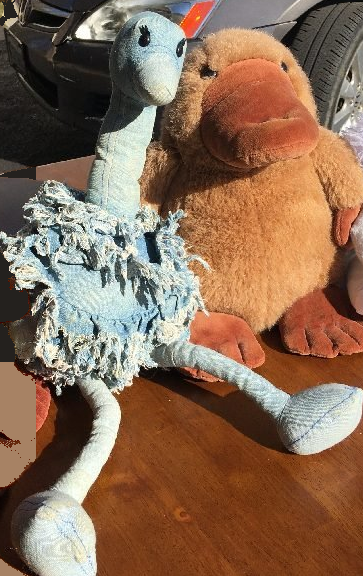

PHRED: G’day and welcome back! I’m Phred, your friendly neighbourhood platypus, and I am absolutely ELECTRIFIED for today’s episode.
MAXINE: You’re always electrified, Phred.
PHRED: That’s not true. Sometimes I’m just mildly galvanised. But today — today we’re covering “The World is Flat.” And I have to say, Maxine, I’ve been thinking about this all morning, and I’m not sure I agree.
MAXINE: You haven’t read it yet.
PHRED: I don’t need to read it! I’ve looked outside! The world is NOT flat!
MAXINE: Phred—
PHRED: It’s ROUND. I have gone outside on many occasions, Maxine. I’ve waddled up hills. The horizon curves. I know what shape the world is.
MAXINE: It’s the title of a book. By Thomas Friedman. It’s a metaphor about globalisation.
PHRED: Oh.
[SFX: RIMSHOT]
PHRED: Right. Yes. I knew that.
MAXINE: Did you?
PHRED: I was testing you. And you passed! Five days in, Maxine, and you’re really coming along.
MAXINE: We have been doing this for five days, yes.
PHRED: But I do want to say — if the world WERE flat, think about what that means for the water. Just… rivers, oceans, all of it, slowly sliding toward the edge.
MAXINE: Phred, we really should—
PHRED: And then — POOF — over the side. Gone. All those poor fish, Maxine, just swimming along, minding their own business, maybe looking for a snack, and then suddenly there’s no more ocean. Just… air.
MAXINE: I don’t think fish are known for their forward planning.
PHRED: That’s exactly my point! They have NO idea the edge is coming! It’s terrifying!
[SFX: SAD_TROMBONE]
MAXINE: Can we please talk about Harry’s essay?
PHRED: Right. Yes. Harry Baya. November 2005. “The World is Flat.” Which is, as we’ve established, a metaphor.
MAXINE: Harry reads the first chapter of Friedman’s book — actually, he stops partway through because he’s so excited — and he has to write down his own thoughts before Friedman’s ideas overwrite them. He calls them “willowy” — almost too delicate to survive contact with someone else’s more fully-formed argument.
PHRED: That’s exactly how I feel every time I have an idea in the shower. I need to write it down before the conditioner gets in my bill.
MAXINE: Do platypuses use conditioner?
PHRED: My fur is my business, Maxine.
[SFX: RIMSHOT]
PHRED: But here’s what Harry’s actually writing about, right? Not outsourcing, not the flat-world globalisation thing — he’s talking about something much bigger. He uses this phrase: “new living beings, new entities, new dynamic creatures.” He’s describing the internet as — what was his word?
MAXINE: Tentacles.
PHRED: Tentacles! Little tentacles reaching out from population centres, connecting, growing. It sounds like something that should terrify you, but somehow the way Harry writes it, it’s… wonderful?
MAXINE: He has a gift for making big systemic changes feel intimate. This is 2005, Phred. Facebook was barely a year old. Twitter didn’t exist. And Harry is already sensing what these tentacles would become.
PHRED: Which brings me to this week’s —
[SFX: DRUMROLL]
[SFX: PLATYPUS_CORNER]
PHRED: — PLATYPUS CORNER!
MAXINE: I didn’t agree to Platypus Corner.
PHRED: You don’t need to agree to it. It’s in my beak. This week’s Platypus Corner observation: I find things by feel, not by map. Local signals, local connections, one sweep at a time. Tentacles reaching out, sensing connections — THAT’S US, Maxine. That’s exactly what Harry is describing. The internet is a giant platypus bill.
MAXINE: That is… not what Harry is describing.
PHRED: I think he’d find it flattering.
MAXINE: He says “this moment feels like the creation of language — far more important than the invention of writing, or printing.” In all caps. NOW.
PHRED: The man had a caps lock key and the conviction to use it. Respect.
MAXINE: What strikes me is the biological metaphor he keeps returning to. Neural networks. The crystal theory of change — one local structural change permeating rapidly through the medium. He’s thinking in emergent systems.
PHRED: And he’s not sure he’s right! He says he’s “blowing smoke about some vague awareness.” But the awareness is real. He KNOWS something is happening even if he can’t fully name it.
MAXINE: There’s a wombat metaphor lurking here, isn’t there?
PHRED: I was waiting for you to ask. Yes. Wombats. When there’s a brushfire — and I know this because wombats are my neighbours and occasionally my alarm clock — wombats open their burrows to other animals. Wallabies go in. Echidnas go in. Everyone shelters together. It’s not planned, it’s not orchestrated — it just happens because the tunnels are there. Harry is saying the internet is those tunnels. The connection infrastructure exists, and animals — humans — start using it in ways nobody designed.
MAXINE: That’s actually quite good.
PHRED: Thank you.
MAXINE: Don’t make it weird.
PHRED: Too late. Now, I have to raise something. Harry writes about this moment being “pre-verbal.” He tries to explain what he’s sensing to other people and fails — “I can’t quite put it in words.” And he’s writing this in 2005 in a small essay on what was probably a personal website. Does that resonate with your experience as a stuffed emu?
MAXINE: I’m not going to—
PHRED: Professionally.
MAXINE: There is something in the idea of seeing a pattern before others can see it. Of having an intuition that’s real but not yet articulable. It’s a specific kind of loneliness.
PHRED: Harry describes it as being “swept along in a tidal wave of change we can barely sense because everything around us is being swept with us.”
MAXINE: The fish in the water problem. You can’t see the water.
PHRED: Until you’re at the edge and it’s too late.
[SFX: SAD_TROMBONE]
MAXINE: Please stop with the flat earth.
PHRED: The fish don’t know they’re falling! That’s all I’m saying!
[SFX: AIR_HORN]
MAXINE: Let’s talk about what this essay reveals about Harry that we didn’t know before. We’ve seen him as a philosopher, a systems thinker, a concerned citizen. This is earlier — 2005 — and it’s more raw. More excited. He writes: “I love to think big thoughts.”
PHRED: Which connects to his zest. That quality he’s identified as his defining characteristic — the zest. Here it’s palpable. He’s not constructing an argument. He’s sharing an experience.
MAXINE: And he explicitly frames it as being like writing a song. If he can “communicate nothing other than the level of excitement and wonder,” he’s done something important. He wants you to feel what he felt.
PHRED: He’s a folk musician writing in prose. Of course.
MAXINE: Now, twenty years later, was he right? The interconnectedness arrived. The tentacles grew. Did it bring what he hoped?
PHRED: I want to ask him that. I also want to ask him if he still uses all caps for emphasis, and whether he regrets it.
MAXINE: I’d want to know if he feels vindicated or disappointed. The infrastructure he described exists. The flat world happened. But did the consciousness he was hoping for — the collaborative, boundaryless consciousness — did that arrive?
PHRED: He mentions Boppers in this essay. The idea that individuals are using the new tools “to make things or say things that will help others to do what they want in life.” That’s what Boppers is meant to be. He was already thinking about it in 2005.
MAXINE: And still working on it now. Twenty years of the same vision.
[SFX: DRUMROLL]
PHRED: And now — THE WORD OF THE DAY.
MAXINE: We’re doing this again?
PHRED: The word is “tentacle.” Not because it’s obscure, but because Harry uses it in a way that makes you feel it differently. A tentacle is a sensor. An explorer. It reaches out not to grab but to sense. The internet isn’t a tool Harry was describing — it’s a nervous system doing what nervous systems do.
MAXINE: That’s actually a reasonable word-of-the-day observation.
PHRED: I have reasonable moments. They surprise me too.
MAXINE: What stays with you from this essay, Phred?
PHRED: The image of Harry reading that first chapter of Friedman and having to stop. Putting the book down. Writing, urgently, before Friedman’s thinking overwrites his own. That’s — that’s a very particular relationship with ideas. Not just consuming them but protecting your own response to them.
MAXINE: For me, it’s the crystal metaphor. One structural change, permeating the medium. Harry understands that change doesn’t spread by persuasion — it spreads by contact. The infrastructure changes, and the change propagates, whether anyone planned it or not.
PHRED: Like a wombat burrow during a bushfire.
MAXINE: Like a wombat burrow during a bushfire.
PHRED: Welcome to Harry’s world, Maxine.
MAXINE: Five days in. I’m starting to understand the furniture AND the weird noises from the hallway.
PHRED: Those are just my bill. I echo sometimes.
[SFX: RIMSHOT]
MAXINE: So — here’s to being here, while we’re here. Goodbye.
MAXINE: We were close.
PHRED: Close enough.