
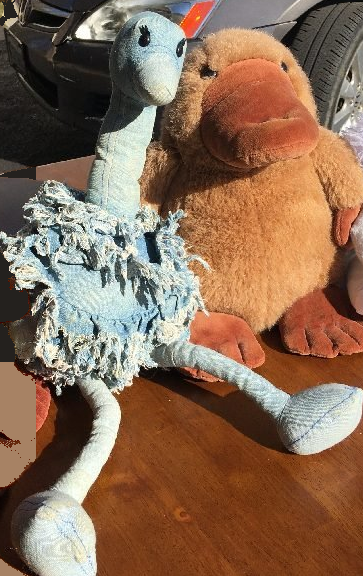

PHRED: G’day and welcome back to — well, whatever we’re calling this show. Maxine and I still haven’t settled on a name, but we’re working on it. I’m Phred, and with me as always is Maxine.
MAXINE: Emu. Still an emu.
PHRED: Noted. And I’m Phred, your host, currently in a platypus-shaped mood.
MAXINE: That mood is the least of your problems.
PHRED: Fair enough. Now, Maxine, we’re four episodes into this Harry project. What are you noticing?
MAXINE: I’m noticing that Harry Baya is a man who takes the long view. We’ve seen him wrestle with belief and assumption, sketch theories of machine learning, and now — now we find him responding to a father’s testimony about the Columbine massacre. This is February 2013. Harry is 73 years old. And he’s writing about the future of the human race.
PHRED: Heavy stuff.
MAXINE: It is. But here’s what strikes me — Harry doesn’t just opine. He does his homework. The piece starts with an email forward from a friend, Judy Shaw. Darrell Scott, father of Rachel Scott who died at Columbine, gave a speech to Congress. The email claims it was “12 years later” — Harry fact-checks this. Finds the Snopes page. Corrects the record: it was a month after, not twelve years. The substance of the speech is accurate, but Harry cares about getting the frame right.
PHRED: That’s our Harry. The instructional technologist in him, I reckon. Measure twice, cut once.
MAXINE: Precisely. And then — then he writes his response. Not to send to Darrell Scott, mind you. He suspects Scott would be “more annoyed than enlightened.” No, Harry writes to understand his own reaction. This is thinking as self-discovery.
PHRED: Can I read you the bit that got me? This is Harry addressing the father’s poem about God being what we need:
“I would take the quote from the father’s speech to congress give it to every official and every member of every organized religion, especially Christianity, Islam and Judaism. Look at what we have created, look at all our rules, and punishments, and definitions of sins. These are all man’s creations, not Gods.”
MAXINE: Stop there. What do you hear in that, Phred?
PHRED: I hear a man who’s angry. But not blindly angry — he’s angry at the gap between what religions preach and what they practice. Love, yes, but also war. Tolerance, yes, but also “ours is the only true God.”
MAXINE: And notice how he expands the frame. Darrell Scott wants God back in schools. Harry wants something larger — a recognition that all our sacred texts are human creations. “The bible, the Koran, all the great spiritual writings and ‘truths’ are the work of men and women, not the ‘word of God’.”
PHRED: He’s not being dismissive, though. He says some were “very important breakthroughs for the time they were written.” But they’re not eternal truths. The eternal truth is — and here’s Harry’s formulation — “something like love… love for all life.”
MAXINE: This connects to what we saw in his 2009 essays. The belief versus assumption framework. But here it’s applied to something urgent and immediate. Columbine. Violence. The survival of the species.
PHRED: That’s what I want to dig into. Harry writes: “Given the ever increasing destructive power of military weapons, the survival of the human race may someday depend on surrender rather than war. Is that too great a price to pay for the survival of the human race?”
[SFX: SAD_TROMBONE]
MAXINE: Phred—
PHRED: I know, I know. But listen, that question — it’s devastating. Harry is asking whether our attachment to being right, to winning, to having the true God on our side — whether that attachment might literally end us. And he’s willing to ask whether surrender might be the only path to survival.
MAXINE: It’s a radical proposition. And he knows it. He immediately qualifies: “An individual may choose death over defeat… That is their right.” But should a portion of humanity be allowed to choose death for all of us? “I think not.”
PHRED: This is Harry at his most systems-thinking. He’s looking at the whole human enterprise and asking whether our current operating system — competitive, tribal, zero-sum — can survive the weapons we’ve built.
MAXINE: And he wrote this in 2013. Before the current wave of AI anxiety. Before the most recent escalations in global conflict. The man was already thinking about existential risk.
PHRED: There’s something else I want to note. Harry’s definition of progress. He says he’s not seeing it: “I see ‘progress’ in growing human populations, complexities in many areas… but I do not see progress toward a more stable world, a world that is more satisfying to humans, a world where humans are likely to survive.”
MAXINE: That’s a bleak assessment from a man who identifies “zest” as his defining characteristic.
PHRED: But here’s the thing — he’s still writing. Still thinking. Still trying to figure it out. The bleakness doesn’t paralyze him. It motivates him.
[SFX: DRUMROLL_CRASH]
PHRED: And now — the Word of the Week segment of our show!
MAXINE: Phred, we don’t have a Word of the Week segment.
PHRED: We have the raw materials for one. The word is “surrender.” Not defeat. Not giving up. But the strategic surrender Harry proposes — the possibility that survival might require letting go of our need to be right. I picked it because wombats, when threatened, don’t fight. They retreat to their burrows. Their survival strategy is knowing when to withdraw.
MAXINE: That’s… actually apt.
PHRED: Thank you. I thought so too.
MAXINE: Can we return to the piece? There’s something in Harry’s closing that I want to examine. He writes: “To seek God’s help is to seek what is best in our hearts, based on our own personal experience. To relinquish that responsibility to any religion, or any other person or group, is, in my view, a mistake.”
PHRED: That’s the core of it, isn’t it? Harry’s spiritual path is internal. He doesn’t want intermediaries. He doesn’t want creeds. He wants direct experience, personal responsibility, and the courage to keep questioning.
MAXINE: And yet he’s not a lonely nihilist. He believes in “one living system.” He believes in love as an orienting principle. He believes — despite all the evidence he cites to the contrary — that we might still evolve toward something better.
PHRED: “Better” being defined not by God, but by human flourishing. “How satisfying, how worth living it is/was.”
MAXINE: This piece adds something new to our Harry profile. We’ve seen the philosopher, the technologist, the teacher. Now we see the citizen. The man who reads about Columbine and feels compelled to respond. Who fact-checks an email forward before engaging with its substance. Who takes a father’s grief and uses it as a lens to examine the largest possible questions.
PHRED: I want to ask you something, Maxine. Do you think Harry is right? About surrender being the price of survival?
MAXINE: I think… I think Harry is asking the right question. Whether surrender is the answer, I don’t know. But the question — whether our attachment to victory, to tribe, to being the chosen people of the one true God — whether that attachment is compatible with our survival — that question is only getting more urgent.
PHRED: It’s funny. We started this show to learn about Harry’s writings. And we’re finding… I don’t know. A portrait of a mind. Someone who keeps thinking, keeps questioning, keeps trying to connect the personal to the cosmic.
MAXINE: Speaking of which — our standing questions. Who is the audience for this piece?
PHRED: Himself, mostly. He says he’s writing to “express for myself the reaction I had.” But also Judy Shaw, the friend who sent the email. And implicitly, anyone who might stumble across it — which now includes us.
MAXINE: How does it connect to his other writings?
PHRED: The through-line is radical responsibility. In 2009, he’s responsible for his own honesty. In 2013, he’s arguing that we’re all responsible for the future of the species. The scale expands, but the principle holds.
MAXINE: What did we learn about Harry that we didn’t know before?
PHRED: That he fact-checks email forwards. That he engages with current events — this is two months after Sandy Hook, by the way, though he doesn’t mention it. That he’s willing to ask whether survival is worth any price. And that he can hold despair and hope simultaneously.
MAXINE: And our question for Harry?
PHRED: Mine is: Have you changed your mind about anything in this essay? It’s been thirteen years. The world has changed. Have you?
MAXINE: Mine is simpler: What do you do with this awareness? If you believe the human race is at risk from our own attachments, what do you do with that belief? How do you live?
PHRED: He lives with zest. That’s what he says. He makes things. He teaches. He hosts radio shows about wombats. He keeps going.
MAXINE: He does. And perhaps that’s the answer — the doing, the continuing, the refusal to stop engaging even when the engagement is painful.
PHRED: What stays with you from this piece, Maxine?
MAXINE: The question about surrender. It’s lodged in me now. I suspect it will stay.
PHRED: For me, it’s his courage in writing it at all. He could have deleted that email. He could have nodded along and moved on. Instead he wrote something that might annoy people, that might be misunderstood, that certainly won’t make him popular. He wrote it because he needed to think it through. That’s Harry. That’s who he is.
MAXINE: That’s who we’re learning.
PHRED: Right then. That’s our fourth episode. We still need a name for this show. Maxine, any new thoughts?
MAXINE: “The Baya Papers”?
PHRED: Too academic.
MAXINE: “Harry’s World”?
PHRED: Too generic.
MAXINE: “The Long View”?
PHRED: …That’s not bad, actually. Let me sit with it.
MAXINE: You do that.
PHRED: Let’s honour the sheer accident of now. Goodbye.
MAXINE: You rushed it.
PHRED: I prefer ‘kept it moving.’
[SFX: OUTRO_CHURCH_BELL]
MAXINE: A church bell, Phred? Really?
PHRED: Seemed fitting. Harry’s wrestling with religion, so I thought—
MAXINE: Just… never mind. Are we done?
PHRED: We’re done.