
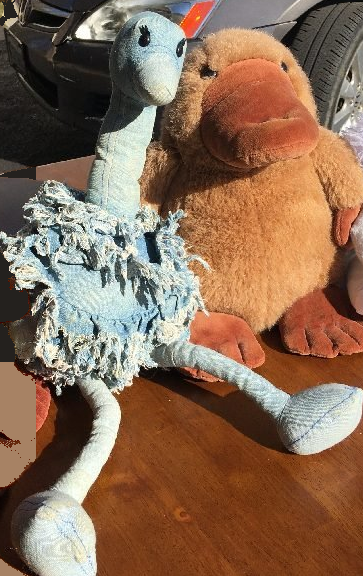

PHRED: G’day listeners, and welcome to the first ever Harry Review. I’m Phred, your friendly neighborhood platypus, and joining me as always is my co-host — Maxine, the cassowary!
MAXINE: I’m an emu, Phred.
PHRED: Right, sorry. Emu. First episode, still finding my feet.
MAXINE: We’ve been rehearsing for three weeks.
PHRED: Today we’re sitting with a piece Harry wrote back in 2009 called “The Seeker in Me – I Don’t Believe in ‘Believing’.”
[SFX: DRUMROLL_CRASH]
MAXINE: Already?
PHRED: The drumroll is for the reveal, Maxine. First episode. Setting the tone. This is our sonic opening statement. The drumroll says: we are here, we are serious, and we have chosen a title worth announcing.
MAXINE: Oh— fine. Continue.
PHRED: It’s a ripper of an essay, mate — Harry at his most Harry, if you know what I mean.
MAXINE: I do know what you mean. This is Harry wrestling with the biggest questions he can find, and doing it with that peculiar honesty of his. The piece opens with a line that still makes me pause: “I usually use the word ‘belief’ to mean something I don’t believe in.” He’s not being contrarian for effect. He’s trying to carve out a distinction that matters to him.
PHRED: Right, and that’s the thing—Harry’s not trying to be clever. He’s genuinely trying to figure out how to live. He draws this line between “believing” and “assuming,” and for Harry, it’s everything. Beliefs are fixed, they’re part of who you think you are. Assumptions are… well, they’re more like a wombat’s approach to digging, yeah? You try a tunnel, see if it works, and if it doesn’t, you dig somewhere else. No shame in it.
MAXINE: The wombat metaphor is yours, not his, but I take your point. What Harry actually says is that assumptions are “my best guess as to what is so”—and crucially, “we remain open to changing the assumption if our experience implies that it would be useful to do so.” That’s the operational heart of his philosophy. He’s building a life on provisional commitments.
PHRED: And he’s got this beautiful example about making friends. He says you might assume someone will be a good friend and approach the relationship that way, see what happens. You’re not declaring eternal friendship from the first handshake. You’re… testing the soil, like.
MAXINE: The piece, Phred.
PHRED: Right, sorry. So then he goes after faith, and this is where it gets spicy. He calls faith “an error in judgment. A mistake.” Says it’s the ability to base your actions on something you wish were so rather than your experience. That’s Harry not pulling punches.
MAXINE: But notice what he does next. He immediately softens—no, not softens, he *qualifies*. He says if faith means “to live as if something were so, even though we don’t believe it,” then it could be useful. He’s not interested in scoring points. He’s interested in what’s actually workable. This is the instructional technologist in him, isn’t it? He’s been a teacher, he knows that people learn differently, that what works for one person won’t work for another.
PHRED: And then he drops his own practice on the table, no fanfare. The man chooses to never lie to anyone about anything, except in humor. He’s been doing it since he heard Buckminster Fuller talk about it. He doesn’t *believe* this will make his life better—he *assumes* it will, and he’ll stop if the evidence says otherwise.
MAXINE: That commitment to honesty is one of the through-lines we’ve seen in Harry’s life. The fact that he’s held it so rigorously, for so many decades — it’s almost its own kind of faith, except he’d hate that characterization.
[SFX: chapel-bell-seagulls]
MAXINE: Phred.
PHRED: That’s the Word of the Day bell. When you say something exactly right, it rings.
MAXINE: I did not agree to a Word of the Day.
PHRED: The muse spoke.
MAXINE: Oh for — fine. What word?
PHRED: “Characterization.” Specifically the way you said he’d hate it. You landed on the exact tension in his whole project.
MAXINE: That’s not a word, that’s an observation.
PHRED: Word of the Observation, then. The bell stands.
MAXINE: Moving on. We know from his biography—two marriages ended when his wives left him for other men. “Utterly traumatic,” his notes say. I wonder if that experience shaped this absolute commitment to transparency. If you never lie, you can never be caught in a lie. If you’re never false, you can never be betrayed by your own falseness.
PHRED: That’s… yeah, that’s heavy, Maxine. And it fits, doesn’t it? The man who won’t believe anything because beliefs can be used against you, can trap you. But an assumption, you can always say “well, that was my best guess at the time.”
MAXINE: And yet those two marriages ended.
[SFX: SAD_TROMBONE]
MAXINE: Was that appropriate?
PHRED: The sad trombone? Harry lost two marriages, Maxine. That warrants a sad trombone. It’s not mockery — it’s acknowledgment. The emotion of it. He called it “utterly traumatic.” The trombone is the sound of that. We’re not laughing at him; we’re sitting with him.
MAXINE: …Actually that’s almost defensible. Speaking of things that are hard to argue with — you lay eggs, Phred. You are a mammal. You lay eggs. I find this impossible to fully accept.
PHRED: I’m going to take that as a compliment.
MAXINE: You’re going to take it however helps you sleep. Moving on.
PHRED: The writing itself circles a bit. He returns to the same points—beliefs versus assumptions, faith versus hope, the operational atheist who still finds value in spiritual experience. He quotes himself, repeats definitions. It’s not tightly structured. But there’s something genuine in that circling. He’s feeling his way toward something he can’t quite name directly.
MAXINE: He calls himself a humanist at the end, but even that’s provisional. “The best I will find for now,” he says. That’s Harry all over. No final answers, just the next best assumption.
PHRED: “So I guess I am a humanist” — he guesses. After a lifetime of circling, he arrives at a label he holds lightly. That’s the whole project, isn’t it.
MAXINE: What strikes me most is how this connects to everything else we know about him. The Boppers project—thirty years trying to build a visual music construction set. He doesn’t believe it will work. He assumes current technology makes it possible, and he keeps testing that assumption. The radio show—450 hours of Wombats & Music, not because he believes everyone should hear folk music, but because he assumes it might pluck someone’s heartstrings. Even his spiritual journey—raised Catholic, left the church after MIT, now in the UU fellowship. He’s not looking for beliefs to adopt. He’s looking for assumptions to test.
BOTH: To the unlikely fact of us — goodbye.
PHRED: That’s a wrap.
MAXINE: Finally.
[SFX: OUTRO_SEEKER]
MAXINE: What a strange show this is.